
Last updated:
Key Takeaways
- BYD is recruiting over 9,000 employees at its Ebu components and Xiaomo vehicle plants in Shenshan Special Cooperation Zone, Guangdong, China.[1]
- The hiring drive is primarily driven by a near-doubling of overseas sales in the first half of 2026, even as domestic EV market growth cools.[2]
- BYD’s strategy highlights its increasing focus on export capacity and logistical optimization in a competitive global EV landscape.[3]
Overview: BYD’s Expansion in Shenshan
On the heels of record overseas growth, BYD—China’s electric vehicle giant—has committed to hiring around 9,000 new employees at two industrial powerhouses: the Ebu components base and the Xiaomo vehicle plant, both situated in the increasingly vital Shenshan Special Cooperation Zone in Guangdong province.[1] This move stands out in a year marked by muted domestic sales growth and growing global competition, underlining BYD’s capacity to adapt and scale for a shifting market. Unlike retrenchment strategies seen elsewhere in the industry, BYD’s hiring surge reveals its ambition to strengthen supply chains, boost export capability, and maintain its position as a global leader in electric vehicles.
Inside the Hiring Drive: Ebu and Xiaomo Breakdown
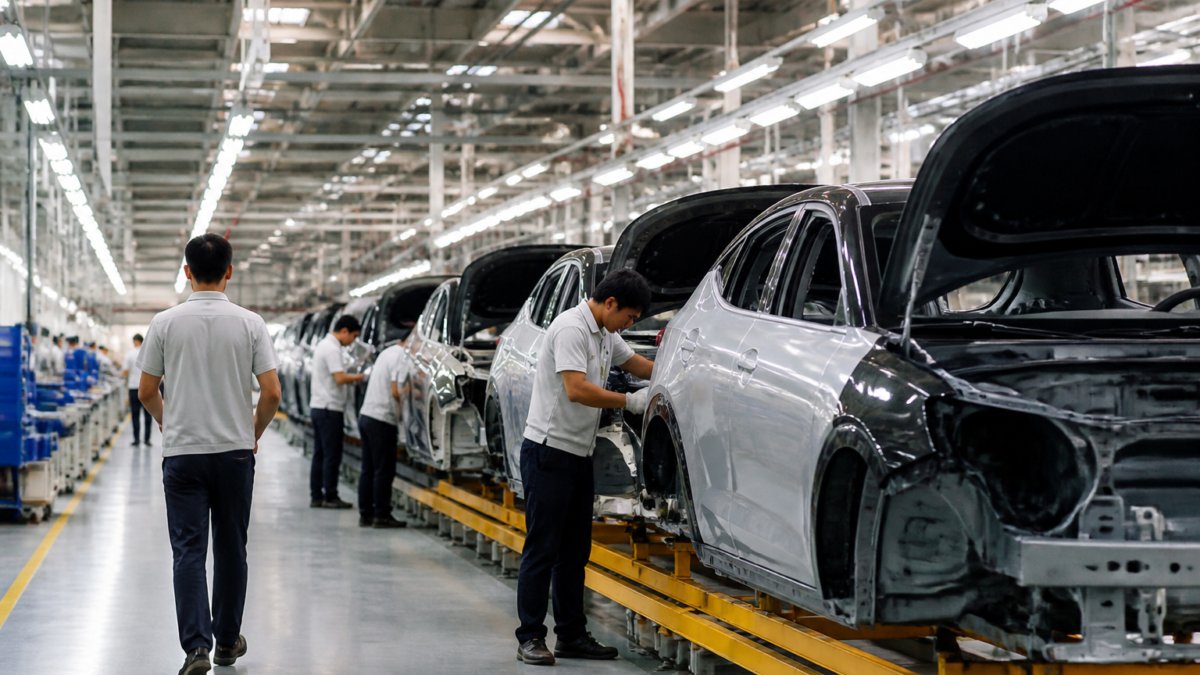
The 9,000-plus positions are not randomly distributed: they target critical arms of the manufacturing process and workforce expertise. At the Xiaomo plant, Division 11 alone is looking to take on about 4,800 specialists covering sheet-metal workers, upholstery technicians, and warehouse staff. Division 15 at Xiaomo seeks an additional 1,200 hires focused on assembly, welding, and foaming processes. Meanwhile, Ebu’s Division 15 is set to receive roughly 2,000 new recruits for production operation roles such as machine adjusters and welders.[2] This strategic hiring profile underscores BYD’s urgent need to increase throughput and meet export-driven production targets.
| Facility | Division | Role Focus | Planned Hires |
|---|---|---|---|
| Xiaomo | 11 | Sheet-metal, Upholstery, Warehouse | ~4,800 |
| Xiaomo | 15 | Assembly, Welding, Foaming | ~1,200 |
| Ebu | 15 | Production, Machinery Adjustment, Welding | ~2,000 |
The Overseas Sales Surge: What’s Fueling BYD?
BYD’s dramatic hiring spree is fundamentally a response to a new locus of demand: exports. In June 2026 alone, the company’s overseas sales surged by 94.7% year-on-year, reaching 175,349 units—outpacing its domestic growth.[1][3] Key export models include the Fangchengbao Tai 7, Song Plus, and Song Pro. While China’s once breakneck domestic EV sales have become more subdued in the past year, BYD’s bets on international markets—from Latin America to Europe and Southeast Asia—appear to be paying off, and the company is intent on ensuring it can supply this surging demand.
Domestic Downshift and Global Ambitions
China’s EV market, long the world’s largest, is experiencing a period of slowing—though not reversing—sales growth due to market saturation and intensified competition. BYD’s decision to add thousands of employees amid this domestic moderation is notably contrarian: rather than cut back, BYD is increasing capacity aimed squarely at export. This is not a sign of strategic drift but a calculated response to global market signals, positioning the manufacturer for further international penetration.[2]
Why the Shenshan Special Cooperation Zone?
The choice of location is no accident. The Shenshan Special Cooperation Zone, which includes both the Ebu and Xiaomo industrial bases, is not only a productivity hub but also a strategic logistics nexus. Close to Shenzhen and Shantou and strengthened by newly developed high-capacity logistics and warehousing infrastructure, Shenshan enables BYD to streamline cross-border shipments. This integration is critical for the rapid export of finished vehicles and knock-down (KD) kits, helping BYD maintain reliability and speed in its international deliveries.[4] Effective logistics underpin BYD’s capacity to fulfill overseas orders efficiently and flexibly.
Implications for the Global EV Industry
BYD’s hiring wave does more than address labor needs; it reflects an acceleration of the regionalization and globalization trends under way in the EV industry. Leading EV makers are focusing on export capacity, flexible production, and agile supply chains. BYD’s operational choices highlight the critical role of labor and logistics infrastructure as competitive advantages in a market increasingly dominated by export- and innovation-driven cycles.[3]
Questions to Ask if You’re Following EV Workforce Trends
- Does high-volume hiring at BYD forecast similar trends at other regional automakers?
- Will increasing focus on overseas capacity mean less innovation for BYD’s home market?
- How is workforce allocation between automation and human labor evolving in EV production?
- Could operational costs from this growth surge impact BYD’s future pricing flexibility?
- Will Shenshan’s logistics become a model for other industrial zones?
Frequently Asked Questions
- Why is BYD hiring so many workers in Shenshan?
- BYD’s 9,000-plus hiring initiative is directly tied to a rapid rise in overseas sales and the need to boost export production, rather than a growth spurt in China’s domestic EV market.[1]
- What types of jobs are being created?
- The positions cover skilled trades (sheet-metal, upholstery, welders), assembly, warehouse management, and machinery operations at both Ebu components and Xiaomo vehicle facilities.[2]
- Are these roles permanent or temporary?
- Available sources state these are standard employment roles to meet sustained export demand; there is currently no evidence suggesting mass temporary or short-term contracts.[3]
- Is BYD scaling back elsewhere as it hires in Shenshan?
- No announcements have been made about large layoffs or production cuts in other regions; the hiring appears to be net expansion, not redistribution.[2]
- How does the Shenshan zone’s logistics benefit BYD?
- The zone offers integrated industrial and logistics facilities, including warehousing near ports, allowing rapid export and efficient supply chain management.[4]
- Will the focus on overseas markets continue?
- Given the scale of recent overseas sales growth—almost double year-on-year—and BYD’s explicit capacity buildout, international expansion is likely to remain central.[3]
Conclusion: BYD’s Hiring—A Calculated Bet on the World
BYD’s recruitment of over 9,000 workers for the Ebu and Xiaomo sites is more than a numbers story; it’s an indicator of how EV manufacturing responds to shifting global markets. While domestic EV growth cools, BYD is using its resources to serve export opportunities driven by rapid overseas demand. The investments in logistics and operational scale at Shenshan may well become a template for other Chinese—and global—automakers. Unlike speculative strategies, this is a clear, well-documented commitment to competitive capacity building. For those watching the trajectory of the electric vehicle industry, BYD’s bold hiring is a signal: the global EV supply chain is about breadth, speed, and the agility to capture emerging market surges.[1]








Leave a Reply