
Last updated:
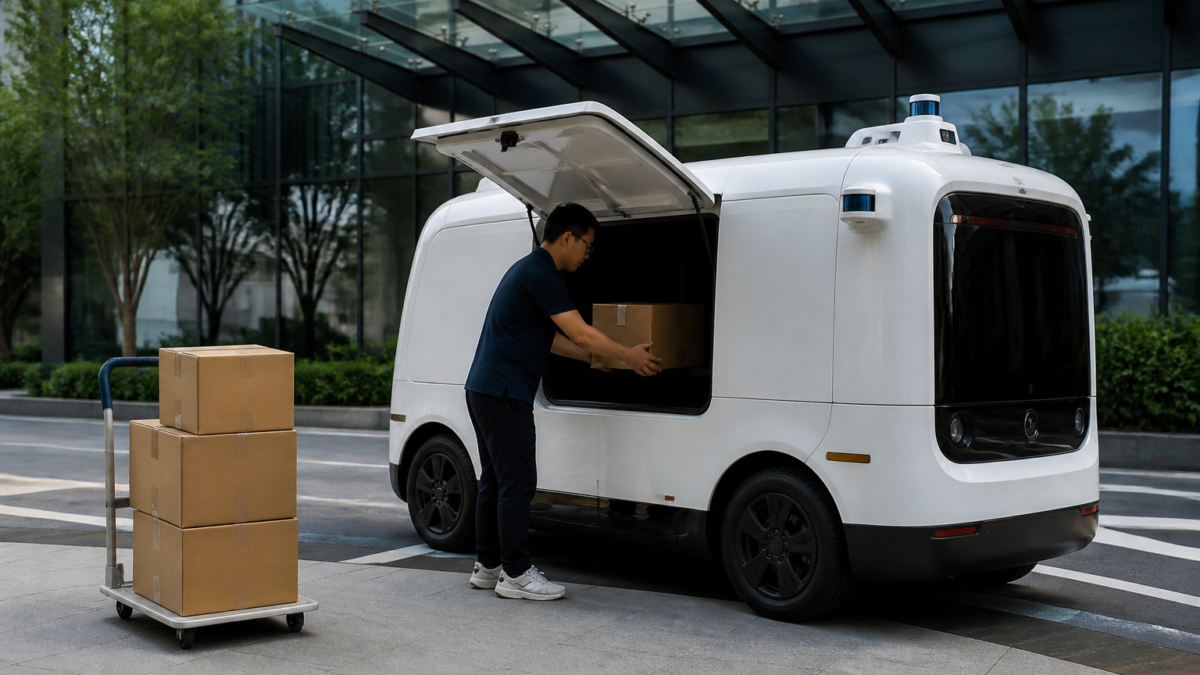
The landscape of autonomous vehicles is evolving rapidly, and few companies embody this shift more than Momenta. In July 2026, Momenta reaffirmed its commitment to autonomous mobility by launching full-scale robovan operations in Suzhou’s Xiangcheng District, delivering parcels 24/7 using their proprietary R7 World Model platform.[1] However, this move is not a complete departure from robotaxis—instead, it illustrates Momenta’s strategy to diversify across autonomous modalities while leveraging shared core technology. The advent of robovans signals a new era in on-demand logistics, propelled by map-free autonomous driving and a scalable AI approach. For logistics professionals, tech enthusiasts, and urban planners tracking the future of last-mile delivery, Momenta’s robovan strategy offers a glimpse into the accelerating transformation of China’s urban logistics sector.
Momenta’s Robovan: Inside the 24/7 Suzhou Deployment
Momenta announced on July 27, 2026, that its robovans were officially in operation in Suzhou’s Xiangcheng District. The robovans, fitted with the R7 World Model system, autonomously deliver express and overnight parcels around the clock. This Suzhou deployment marks the first time Momenta’s advanced commercial vehicles are serving public logistics routes without a safety driver.[1] On-the-ground reports confirm these vehicles are already supporting parcel logistics needs for business districts, leveraging optimized routes and continuous service to increase operational efficiency.[2]
The R7 World Model: Map-Free Autonomous Driving Explained
Central to Momenta’s robovan solution is the R7 World Model—a scalable platform designed to power everything from robotaxis to heavy-duty trucks. Unlike many autonomous solutions that rely on detailed high-definition (HD) maps, R7 enables “map-free” driving by harnessing real-time perception and end-to-end AI decision-making. This innovation allows quicker, more flexible deployment in new cities, as vehicles aren’t tethered to fixed maps.[3] While Momenta claims industry firsts in map-free operation, it should be noted that competitor Neolix has also reported similar achievements; the precise chronology and technical leadership remain debated.[4]
Not a Departure—Momenta’s “Physical AI” Platform Strategy
While some media headlines suggest a full pivot or abandonment of robotaxi operations, Momenta’s own releases clarify a more nuanced strategy. The company is simultaneously advancing its robotaxi, robovan, and robotruck lines, all built atop the scalable R7 World Model platform.[5] This approach optimizes costly R&D expenditures by allowing innovations tested in one vehicle type to benefit others. It also enables Momenta to address both passenger transport and goods delivery needs in China’s rapidly urbanizing environments.
China’s Autonomous Delivery Boom: Market Context
China’s autonomous delivery sector is already among the world’s largest, with more than 33,000 robovans deployed nationwide by the end of 2025. Estimates suggest annual production could reach 860,000 units by 2030, with a total fleet topping 2 million units.[1] This growth is powered by explosive e-commerce demand and a shift toward same-day logistics. Momenta joins companies like Neolix and Uisee in scaling up deployment and pursuing operational efficiency, while adapting to a complex regulatory environment that still requires city-level permits for autonomous vehicle operation.
Advantages and Challenges of Map-Free Robovans
| Feature | Map-Free Robovans (e.g., Momenta) | Map-Dependent Competitors |
|---|---|---|
| Deployment Speed | Rapid—no need for lengthy map creation | Slower—requires high-definition maps |
| Scalability | Easier to expand to new cities | Constrained by map availability |
| Adaptability | Handles changes in real time with AI | May require map updates |
| Technical Maturity | Challenging—requires robust perception | Leverages mature mapping tech |
While map-free driving offers advantages in cost, speed, and deployment agility, it also raises the technical stakes for real-time perception and decision-making. Robust AI and sensor fusion are essential to maintain safety and service continuity, especially when navigating dynamic urban settings.
Checklist: Key Considerations for Robovan Fleet Deployment
- City Approvals: Each Chinese city maintains unique regulatory requirements for autonomous vehicle operations.[1]
- Operational Use Case: Is the robovan needed for dense commercial districts, suburban delivery, or campus logistics?
- Technical Platform: Map-free solutions enable faster launches—evaluate robustness against local competitors’ platforms.
- Integration: Compatibility with existing logistics and fleet management systems.
- Service Hours: 24/7 operations increase throughput and can reduce per-parcel costs.
Frequently Asked Questions
- Is Momenta only focusing on robovans now?
- No. While Momenta has launched commercial robovan operations, the company is clear that it continues to develop both robotaxi and robotruck solutions, all using the same R7 World Model platform.[5]
- What does “map-free” actually mean in this context?
- “Map-free” means Momenta’s robovans do not require detailed pre-built HD urban maps. They use onboard AI, real-time sensing, and the R7 World Model to understand their surroundings as they go.[3]
- Where are Momenta robovans currently operating?
- As of September 2026, Momenta’s robovans are operating in Suzhou’s Xiangcheng District, running 24/7 parcel delivery routes.[1]
- How big is China’s autonomous delivery vehicle fleet?
- By late 2025, China had over 33,000 driverless delivery vehicles. Projections put the 2030 annual production at 860,000 units and a nationwide fleet surpassing two million.[1]
- What differentiates Momenta’s robovans from competitors?
- Momenta emphasizes a map-free, scalable AI approach, sharing the core R7 World Model platform across multiple vehicle types and touting lower deployment costs. However, competitors like Neolix also claim industry firsts.
- Do robovans face fewer regulatory hurdles than robotaxis?
- Possibly, since delivery routes can be more controlled. However, formal regulatory comparisons are limited and all deployments in China must still secure municipal approval.[1]
- Is Momenta considered a global competitor to Amazon or Walmart’s logistics robots?
- Not directly. Momenta is currently focused on the Chinese domestic market. Comparisons with US retail giants are speculative without direct evidence of competition or expansion plans.
Conclusion: The Significance of Momenta’s Robovan Expansion
Momenta’s move into round-the-clock robot delivery vans in Suzhou is a milestone in autonomous logistics. Rather than a full pivot, it marks the outcome of a deliberate platform strategy: deploy core AI and sensing technology across both passenger and goods transport, maximizing R&D efficiency and commercial reach. As China’s robovan fleet accelerates toward millions of units, scalable and map-free solutions like Momenta’s R7 World Model will be tested at the highest commercial standards. For all stakeholders in autonomous vehicles, Momenta’s developments signal that the future of mobility extends well beyond robotaxis, ushering in a new era where physical goods move as autonomously as people—with economic and urban implications that are just beginning to unfold.[6]






Leave a Reply