
Last updated:
The Nothing Ear (3a) are among 2026’s most talked-about budget wireless earbuds thanks to bold styling, powerful bass, and deep customization—all for $99[source]. This review pulls together independent tech-lab tests, real-user feedback, and official specs to show where these earbuds impress, where they’re average, and what sets them apart from competitors. If you’re looking for versatile sound you can truly tweak, advanced features like on-bud recording, and noise cancellation that’s genuinely effective for the price, there’s a lot to like here. That said, you’ll want to weigh battery life, microphone quirks, and the lack of wireless charging before you buy.
We examine the full Ear (3a) experience: from unboxing and daily use, to how they stack up against rivals, and answer frequently asked questions. This guide is for anyone considering their first sub-$100 wireless ANC buds, whether you’re pairing with an iPhone, Android or looking for a distinctive look. No detail is left vague; you’ll know clearly if these are the right fit for your ears and needs.
Nothing Ear (3a): Quick Verdict and Key Specifications
The Nothing Ear (3a) earn high marks for style and value with sound quality and customization options few in the $99 segment offer. Here’s the crucial feature breakdown for comparison shoppers:
| Decision Factor | Ear (3a) Specs | Takeaway |
|---|---|---|
| Price | $99 U.S. official list | Strong deal for the feature set[source] |
| Drivers | 12mm dynamic | Bass is powerful, customizable by EQ[source] |
| Bluetooth/Codecs | Bluetooth 6.0, SBC, AAC, LDAC | LDAC for high-quality audio on Android |
| Noise Cancellation | ANC (~25dB measured, not 45dB)[source] | Very strong for the price, not flagship level |
| Battery Life | Up to 10h (earbuds) / 42h (with case, ANC off) | Excellent on AAC/ANC off, drops with LDAC or ANC on[source] |
| Charging | USB-C only, no wireless | Fast top-up, but requires a cable[source] |
| Durability | IP54 (dust, splash) | Fine for rain/sweat, not submersible |
| Multipoint/Connection | Dual-device Bluetooth | Switch between phone/laptop easily[source] |
| Special Features | Audio Snapshots, call recording, advanced EQ | Unique in this price class; see legal/copyright note |
Best for: Bass lovers, commuters, Android/LDAC users, and those who want precise audio controls.
Think twice if: You demand wireless charging, neutral sound out of the box, or impeccable business-call quality.
Style, Comfort, and Build Quality
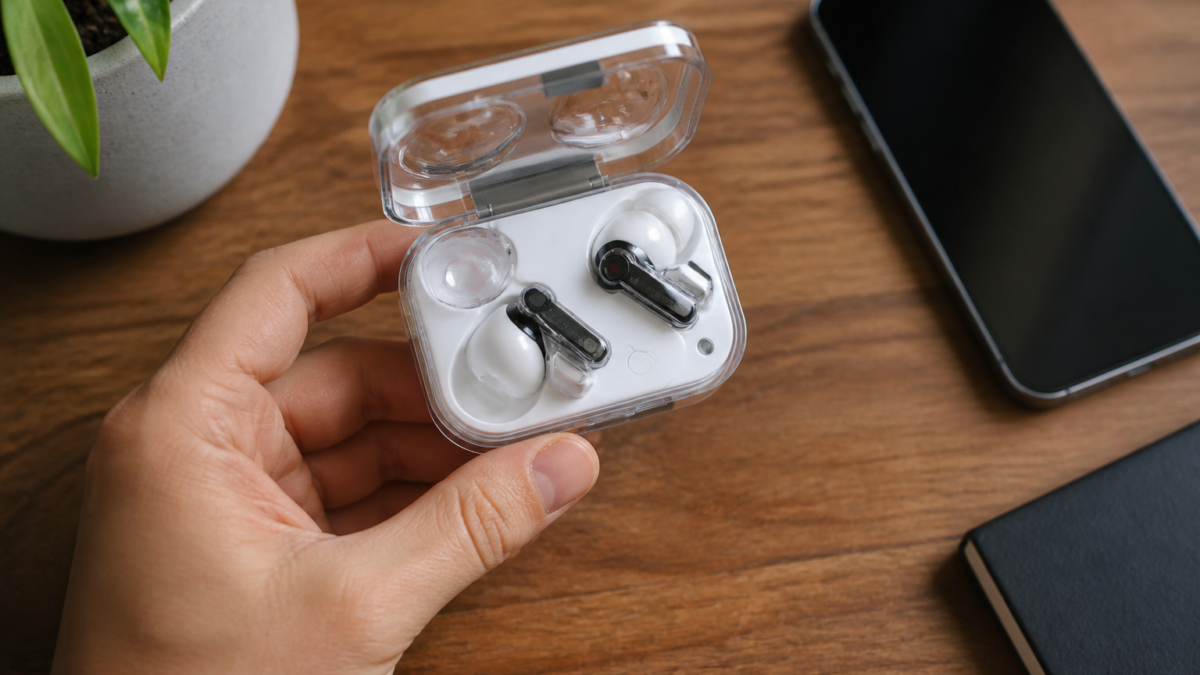
The Ear (3a) stand out thanks to their signature transparent design—available in white, black, yellow, or pink—with bold color accents inside each bud[source]. The case is rounded and more pocketable than before. Reviewers call the fit comfortable and light for most ears, with three tip sizes included. The shallow design is a plus for casual wear, but as always, ear shape matters; secure fit boosts both bass response and noise cancellation performance.
Both earbuds and the case rate IP54 for dust and splash resistance: perfect for sweaty runs or rainy commutes, but absolutely not suitable for swimming or showering. Dry the buds before they go back into the case to avoid charging issues.
Controls use a reliable pinch mechanism on the stem (not sensitive touch pads), reducing false taps when adjusting fit or removing a bud. The Nothing X app lets you customize gestures and check fit with an in-app seal test. In-ear detection will pause your music when you remove a bud.
Note: Some user reports mention occasional alignment hiccups when seating the buds in the case, but this is not widely documented by professional reviewers.[Anecdotal; see editorial notes]
Sound Quality & Customization: Bass-Heavy but Flexible
Out of the box, the Ear (3a) pack a punch with robust bass and a fun, dynamic profile[source]. Kick drums and deep synths get priority, though in default mode, this comes at the expense of vocal clarity and detail on some tracks. If you love energetic music—pop, EDM, house—you’ll appreciate the tuning immediately.
What sets Ear (3a) apart is the advanced EQ in the Nothing X app. Unlike most budget buds, you get an eight-band parametric EQ, dynamic bass control, and user-shared profiles for totally different sound flavors[source]. Suddenly, these become chameleons: knock back the bass and push up mids for podcasts, or build a treble-focused profile for bright acoustic sets.
- Start with the “Balanced” preset to reduce bass bloat.
- Cut sub-bass and mid-bass slightly if vocals sound veiled.
- Use separate EQ profiles for different apps or content types.
- Always test fit first: poor seal makes sound appear hollow or weak.
Codecs: SBC and AAC (native for iPhone), plus LDAC for supported Android phones. LDAC can sound richer with matched high-res files, but drains battery more rapidly.
Spatial audio: The static surround effect adds scale for movies and games, but does not use dynamic head tracking. Purists will prefer stereo for music.
Active Noise Cancellation and Transparency: Effective, with Caveats
Nothing advertises ANC up to 45dB, but lab tests peg real-world reduction closer to 25dB—a solid figure for this class, plenty for droning traffic or commuter rail[source]. You’ll notice less noise on flights or in loud offices, but sharp voices or sudden sounds may leak through. ANC modes include transparency (lets you hear the world) and possible adaptive or fixed levels; what’s confirmed is a reliable basic mode, with detailed level switching unverified in official sources.
Transparency mode is decent for the price—useful for sidewalk safety or catching announcements, but less natural than luxury rivals.
Microphone quality: Noise rejection is strong, especially outdoors. Voice can sound thin or distant, varying by caller and environment—RTINGS called voices “nasal,” SoundGuys noted good wind handling, and others called the audio serviceable but not premium[source] [source] [source].
Battery Life, Charging, Connectivity, and Real-World Use
Battery stats depend heavily on your listening style:
| Mode | Earbuds (per charge) | Total (with case) |
|---|---|---|
| AAC, ANC off | ~10h | ~42h |
| AAC, ANC on | ~6h | ~25h |
| LDAC, ANC off | ~6h | Unspecified |
| LDAC, ANC on | ~4.5h | Unspecified |
These specs generally hold up in third-party tests[source] [source]: expect around 10 hours if you use basic codecs and keep ANC off; 4.5–6 hours with ANC or LDAC. Case rapid-charge gets you an hour of playback from five minutes in the case. There’s no wireless charging; everything is via USB-C.
Bluetooth 6.0 means more robust connections and greater theoretical range (~15m as tested by SoundGuys)[source]. Dual-device multipoint lets you keep the buds paired with both a laptop and phone—great for work/play flexibility. Low-latency mode (<120ms on Nothing phones) is handy for mobile gaming, but console and serious PC gamers will want a dedicated solution.
Audio Snapshot and Call Recording: Unique and Powerful (with Legal Notes)
Perhaps the standout feature: the Ear (3a) buds let you make on-bud audio recordings (call and media). Each bud has 32MB built-in memory to store clips before you transfer them to the Nothing X app. This is ideal for snagging podcast moments or on-the-go voice reminders[source].
Important: Recording calls or conversations comes with legal and ethical responsibilities. U.S. laws vary by state; for interstate calls, assume you need every participant’s consent. A beep or software alert may play, but safe practice is always to clearly inform and get permission from all involved. This feature is not intended for capturing confidential or copyrighted content for redistribution. It may not be enabled in all regions or firmware versions.
Who Should—and Shouldn’t—Buy These Earbuds?
- Go for Ear (3a) if you want:
- Vigorous bass and customizable sound at a budget price
- Fast, flexible connection (Bluetooth 6.0, AAC, LDAC)
- Effective, if not flagship-grade, ANC for everyday noise
- IP54 splash protection and distinctive transparent looks
- Unique features (call/media recording, advanced EQ) not seen below $100
- Consider other options if you must have:
- Wireless charging for the case
- Studio-neutral, ready-out-of-the-box audio
- The most natural voice calls for business use
- Integrated iPhone platform-only features (like H1/Find My)
- Superior gaming sync with consoles or desktop
Practical Setup Checklist
- Update to the newest firmware in the Nothing X app when pairing.
- Test all included ear tips; retest fit if ANC/bass seems weak.
- Place both earbuds in the case firmly and watch for the charge indicator.
- Start with ANC fixed; experiment with transparency and (if available) adaptive modes.
- Cut the lowest EQ bands for less bass/more vocal clarity as desired.
- Use AAC unless you need LDAC’s extra quality (for Android, at a cost to battery).
- Test the microphone and multipoint behavior before your return period expires.
Comparison: Nothing Ear (3a) vs. Major Budget ANC Competitors
| Model | Price | ANC | Wireless Charging | Custom EQ/App | Multipoint | Battery (Earbuds) |
|---|---|---|---|---|---|---|
| Nothing Ear (3a) | $99 | Yes (~25dB measured) | No | Advanced EQ | Yes | 10h (ANC off) |
| Anker Soundcore Life P3 | ~$79 | Yes (~20dB) | Yes | Five-band EQ | No | ~7h (ANC off) |
| Jabra Elite 3 | ~$60 | No | No | Basic presets | No | 7h |
| EarFun Air Pro 3 | ~$80 | Yes (est. 25dB) | Yes | 7-band EQ | No | ~9h |
Frequently Asked Questions
Are the Nothing Ear (3a) worth $99?
For audio tinkerers, bass enthusiasts, and anyone wanting real ANC under $100, the Ear (3a) offer standout features—including flexible EQ, LDAC support, and unique on-bud recording. Buyers prioritizing out-of-the-box neutral sound, wireless charging, or flawless call clarity may wish to compare alternatives[source].
Do the Ear (3a) work on iPhone and Android?
Yes. Nothing X supports both platforms. iPhones get AAC codec, ANC, and EQ. LDAC is only on compatible Androids. Users shouldn’t buy for LDAC unless using Android; otherwise, app features are shared[source].
What’s the real battery life in daily use?
With moderate volume and ANC off, expect 9–10 hours per bud; 4.5–6 with ANC or LDAC. Heavy callers and high-volumers will see less. A single case charge can last weeks for casual use[source].
Are Ear (3a) waterproof?
No. They’re rated IP54: okay for sweat, rain, and splashes but not for immersion or showers. Dry buds before charging to prevent damage. Over time, resistance can decline, so treat with care[source].
Can they connect to two devices at once?
Yes. Bluetooth multipoint means you can switch between, say, a laptop and phone—excellent for hybrid work/study routines[source].
How’s the call quality for work meetings?
Voices are clear enough for most calls, and wind noise is well handled, but multiple reviews note a thin, distant or nasal tone. For mission-critical interviews or podcasts, a dedicated headset remains best[source].
Does the on-bud recording work everywhere?
Most regions support it but legal requirements vary. Always inform and get consent before recording calls/chat, especially with interstate or confidential subjects. Laws differ and the built-in beep is not enough as legal proof.
Conclusion
The Nothing Ear (3a) deliver a rare mix of advanced sound control, lively ANC, bold looks, and creative on-earbud features for their $99 price tag. While the default bass-forward tuning suits modern pop and dance genres, the extensive EQ and codec support open the door to any sound signature you like. Battery life is competitive (if not best-in-class) for the segment, and multipoint helps make these true daily drivers.
Drawbacks? LDAC and ANC take a real bite out of battery. The mic is fine but may not flatter your next presentation. Wireless charging and some iOS-specific tricks are missing. Yet for anyone who wants rich features, style, and strong sound personalization under $100, Nothing’s latest are a clear leader for commuters, students, and style-conscious listeners alike.







Leave a Reply