
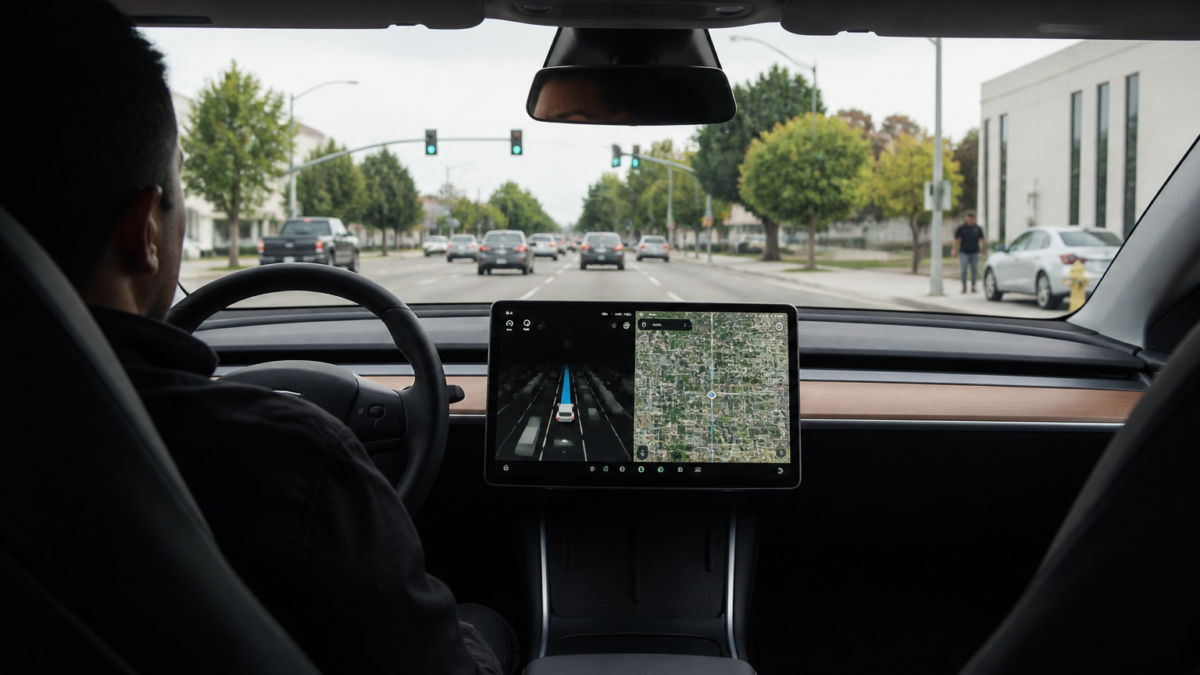
A wrongful-termination lawsuit filed by a former Tesla manager is drawing attention to the company’s vehicle-testing operations in Houston. The complaint alleges that the program became substantially understaffed while Tesla was preparing for a driverless robotaxi service in the city.
The allegations are serious, but they should be understood in context. The lawsuit represents the claims of one former employee, and the available reporting does not establish that every allegation is true. Tesla’s formal response and the case’s eventual legal outcome may provide additional information.
What the lawsuit alleges
According to a report published by Electrek on July 28, 2026, former Tesla manager Javier Medrano filed a wrongful-termination complaint in federal court in Houston. Medrano says he managed Tesla’s Houston Full Self-Driving test fleet before the company launched a driverless Robotaxi service in the city.
The complaint reportedly states that Medrano became the only operational manager responsible for a fleet that grew from approximately 15 vehicles and operators to about 38 vehicles working across three shifts. The filing describes this as a departure from a 15-to-1 safety baseline that Medrano says Tesla had used internally.
His alleged responsibilities included reviewing camera footage, conducting ride-alongs, investigating incidents, and helping oversee the operation around the clock. Medrano claims that the staffing arrangement created a breakdown in safety oversight and contributed to severe exhaustion.
The filing also alleges that test drivers regularly worked extended hours and remained on call during weekends. Medrano says he raised concerns about staffing and requested time away from work in early 2025.
An alleged March 2025 incident
One of the most consequential claims concerns an incident that the lawsuit says occurred on March 30, 2025. According to the complaint, a Tesla test vehicle struck a member of the public at approximately 2:05 a.m.
Medrano alleges that he received an emergency call but was suffering from extreme sleep deprivation. He says he processed the call while not fully awake and later could not recall the guidance he provided. The complaint reportedly states that the vehicle operator remained at the scene for about an hour.
These claims have not been adjudicated. The lawsuit does not, by itself, establish the cause of the reported collision, whether any person was injured, or whether Tesla violated a safety rule. Those questions would ordinarily depend on evidence such as incident records, witness testimony, vehicle data, regulatory filings, and court proceedings.
Why staffing matters in vehicle testing
Testing advanced driving systems involves more than placing a vehicle on a public road. Human operators may need to monitor the vehicle, take control when necessary, report unusual behavior, document incidents, and coordinate with managers or emergency personnel.
Managers also may be expected to review video, track recurring system issues, confirm that operators are trained, and ensure that test procedures are followed consistently. When the number of vehicles increases without a corresponding increase in qualified personnel, oversight can become more difficult.
That does not mean a particular staffing ratio automatically proves that a testing program is unsafe. The appropriate level of supervision can depend on factors such as vehicle capability, operating area, traffic conditions, hours of operation, weather, the number of safety drivers, and the nature of the testing being conducted.
However, fatigue is a recognized operational concern across transportation industries. A person who is responsible for responding to incidents or making safety-related decisions needs sufficient rest and a reliable chain of support. The lawsuit’s allegations therefore raise broader questions about whether Tesla’s Houston operation had adequate redundancy and after-hours coverage.
Full Self-Driving is not the same as a driverless car
Terminology is especially important in this story. Tesla markets Full Self-Driving as a driver-assistance system, not as a vehicle that makes the driver unnecessary in all conditions. Tesla vehicles equipped with the system still require an attentive human driver who is responsible for monitoring the road and taking control.
A driverless robotaxi operation is different. In a genuinely driverless service, passengers would not be expected to supervise the vehicle in the same way as a conventional driver. The service would also require its own operational systems, such as remote assistance, fleet monitoring, maintenance procedures, incident response, and compliance with applicable state and local requirements.
Because of this distinction, reports about Tesla’s FSD testing should not be read as proof that ordinary customer vehicles are operating as fully autonomous cars. They also should not be treated as confirmation that every vehicle associated with a robotaxi program uses the same software, hardware, supervision model, or operating limitations as a consumer-owned Tesla.
What is known about Tesla’s response?
The Electrek report said Tesla did not respond to a request for comment before publication. Without a response from Tesla, the public record described in the report reflects the former manager’s account and the allegations contained in his complaint.
Tesla may dispute the allegations, provide a different explanation for the staffing structure, or challenge the claims during the litigation. The case may also change as the defendant files a response, the court considers motions, or additional documents become available.
At the time of the cited report, the public information available did not establish a final ruling or settlement. Readers should distinguish between a complaint, which sets out one party’s allegations, and a court finding, which results from the legal process and supporting evidence.
Possible implications for Tesla and the industry
The case could matter beyond the employment dispute if the allegations lead to questions about how autonomous-driving test fleets are managed. Companies developing advanced driving systems must demonstrate not only that their software can perform a task, but also that their operational procedures are capable of handling failures and unexpected conditions.
That includes clear escalation procedures, sufficient staffing, accurate recordkeeping, fatigue-management practices, and an independent process for reporting safety concerns. Strong systems should also make it possible for employees to raise concerns without fearing retaliation, although whether that occurred in this case remains disputed and unproven.
Regulators, lawmakers, insurers, and the public may pay close attention to cases involving testing on public roads. Public-road testing can expose members of the public to risks that would not arise in a closed facility, making transparency and incident reporting especially important.
For consumers, the story is a reminder to avoid treating marketing terms such as “self-driving” as a substitute for the actual operating instructions supplied with a vehicle. Drivers should understand the limitations of any driver-assistance feature, remain attentive, and follow applicable traffic laws and manufacturer guidance.
What to watch next
The most useful developments will likely come from court filings and verifiable records. These may clarify the exact claims, Tesla’s response, the employment dispute, and whether the reported vehicle incident is addressed in later proceedings.
Additional information could also show whether the Houston testing program used specific staffing policies, how those policies were documented, and whether Tesla changed its procedures after the events described in the complaint. Until those details are available, the allegations should be reported carefully rather than presented as established facts.
Bottom line
The former manager’s lawsuit raises legitimate questions about staffing, fatigue, incident response, and safety oversight during Tesla’s Houston vehicle-testing program. It is also an allegation in an ongoing legal dispute—not a final determination that Tesla operated unsafe vehicles or violated the law.
The case highlights an important distinction in autonomous-driving coverage: Tesla’s consumer Full Self-Driving system is a supervised driver-assistance feature, while a driverless robotaxi service requires a separate operational and regulatory framework. The eventual court record, Tesla’s response, and any available regulatory findings will be necessary to determine what happened and what lessons the industry should draw from it.
Source context: Electrek’s report on the lawsuit. This article summarizes allegations and does not imply that they have been proven in court.





Leave a Reply