

SEO Strategy for Digital Publishers: A Practical Google-First Guide
For digital publishers, search engine optimization is not a collection of shortcuts for gaining traffic. It is an ongoing editorial, technical, and audience-development discipline. A durable SEO strategy for digital publishers helps readers discover useful articles, comparison pages, guides, category hubs, and resources when they are actively searching for answers.
The central idea is simple: create content people genuinely need, make it easy for Google to crawl and understand, and measure whether your work is improving visibility and reader value. That approach is more dependable than chasing temporary ranking tactics, publishing large volumes of repetitive content, or treating rankings as the only measure of success.
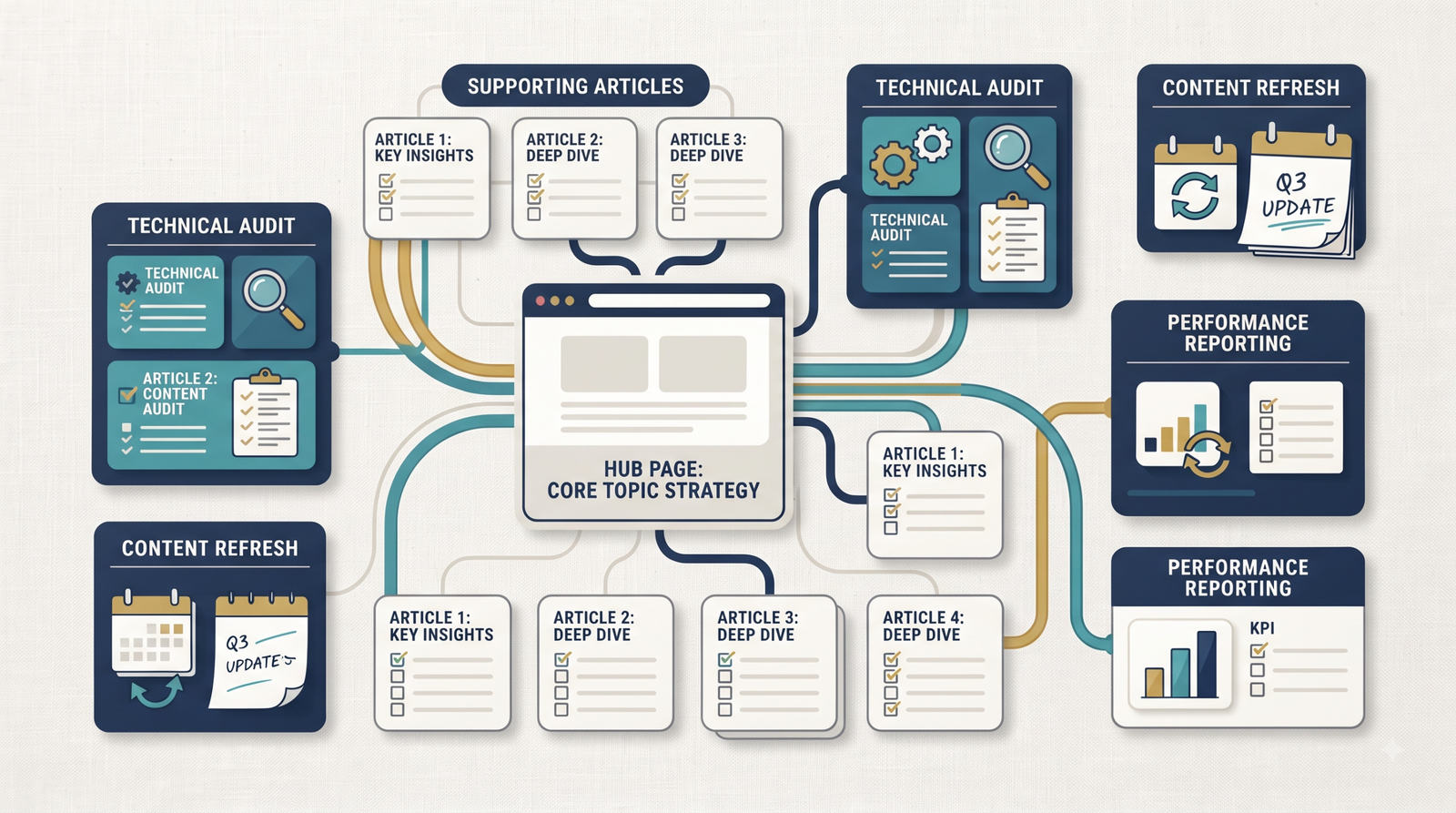
Topic clusters connect a central guide with supporting articles, internal links, technical checks, and regular content updates.
Google states that there are no secrets that automatically rank a site first in search results. Search performance can change as competitors improve, user behavior changes, and Google updates its systems. For publishers, the practical implication is that SEO should be treated as a long-term operating system for content quality, site structure, and continuous improvement rather than a one-time project.
What a Google-first publisher SEO strategy means
A Google-first strategy does not mean writing only for a search engine. It means aligning your publishing process with the fundamentals Google has consistently documented: helpful content, accessible pages, descriptive site organization, and clear signals that help search systems understand what each page is about.
At the same time, successful publisher SEO serves a real business purpose. Organic search can support newsletter signups, repeat readership, affiliate revenue, advertising inventory, product discovery, brand awareness, and lead generation. The best strategy balances those goals with the reader’s reason for searching.
For example, a reader searching for best email marketing platforms for small businesses may want a carefully researched comparison. A reader searching for how to improve newsletter open rates likely needs educational guidance. Publishing the wrong page type for the query can reduce the likelihood that readers will stay, engage, or return.
The four pillars of publisher SEO
| Pillar | What it involves | Why it matters |
|---|---|---|
| Audience and intent | Understanding what readers want at each stage of their search journey | Helps create pages that solve the right problem in the right format |
| Editorial quality | Useful reporting, clear explanations, first-hand insight, sourcing, and updates | Builds trust and differentiates content from generic alternatives |
| Technical foundations | Crawling, indexing, mobile usability, page performance, structured navigation, and canonicals | Allows important pages to be discovered and interpreted correctly |
| Measurement and iteration | Using Search Console, analytics, and editorial reviews to prioritize improvements | Turns SEO into a repeatable process instead of guesswork |
Start with audience intent, not a list of keywords
Keyword research is useful, but a publisher should not begin with a spreadsheet of phrases and immediately assign one article to every variation. That process can create overlapping pages, weak editorial angles, and content that adds little beyond what already exists.
Instead, start by identifying the broader subjects your publication can cover credibly. Then map the questions, needs, and decisions readers have within each subject. This creates topic clusters: organized groups of related pages that help users move from a broad question to a specific answer.
Match content formats to search intent
Most publisher content can be organized around several common forms of intent:
- Informational intent: Readers want to learn, solve a problem, or understand a concept. Examples include explainers, tutorials, checklists, glossaries, and research-backed guides.
- Commercial investigation: Readers are comparing options before making a decision. Examples include product comparisons, buying guides, alternatives pages, and reviews with clear methodology.
- Transactional intent: Readers are ready to sign up, buy, download, or request a service. Publishers may address this through relevant product pages, partner pages, or highly practical recommendation content.
- Navigational intent: Readers are looking for a specific company, publication, tool, author, or resource. Clear site architecture and accurate page titles are especially important here.
Search results themselves can offer useful clues about intent. Review the types of pages that appear, the topics they cover, and the questions they answer. Do not copy competitors page by page. Instead, identify what readers still need: clearer definitions, more current information, practical examples, transparent testing, original reporting, or a better-organized guide.
Build topic clusters with a clear hub page
A topic cluster usually includes one comprehensive hub page and several supporting pages. The hub provides an overview and links to deeper resources. Supporting pages answer narrower questions and link back to the hub when appropriate.
For a digital marketing publisher, a cluster centered on publisher SEO could include:
- A comprehensive guide to SEO strategy for digital publishers
- A technical SEO checklist for editorial websites
- A guide to internal linking for large content libraries
- An article on updating and consolidating old content
- A practical Search Console reporting guide
- A framework for planning comparison and review content responsibly
This structure is helpful because it improves navigation for readers while giving search engines context about the relationships between pages. It also prevents editorial teams from publishing isolated articles with no obvious connection to the rest of the site.
Create content that earns trust and remains useful
Publishers compete in a crowded environment. A page that simply restates common advice without experience, evidence, examples, or a meaningful point of view may struggle to stand out. The goal is not to make every article longer. The goal is to make it more useful than a reader’s next-best option.
Google’s guidance emphasizes creating helpful, reliable, people-first content. In practice, publishers can apply this principle by building clear editorial standards and giving readers enough context to judge the value of a page.
Practical signals of high-quality publisher content
- A clear purpose: The article answers a specific question or helps readers complete a specific task.
- Accurate sourcing: Important factual claims link to credible primary or authoritative sources where possible.
- Original value: The page includes analysis, examples, testing, reporting, expert input, useful organization, or other value beyond a basic rewrite.
- Transparent authorship: Author pages, editorial policies, corrections procedures, and contact information can help readers understand who is responsible for the work.
- Current information: Time-sensitive articles are reviewed and updated when facts, tools, prices, product features, or platform policies change.
- Readable formatting: Helpful headings, concise paragraphs, tables, images, and lists make long-form content easier to use.
Use experience carefully in reviews and affiliate content
Affiliate and commercial content can be useful when it is created to help readers make better decisions. The risk arises when pages are thin, overly promotional, or produced at scale with little independent value.
For reviews, comparisons, and recommendation pages, explain how products were evaluated. If you tested a tool, describe the testing criteria. If a product was not directly tested, do not imply otherwise. Clearly disclose affiliate relationships where applicable, and ensure disclosures are easy for readers to find. Requirements can vary based on your business and audience, so publishers should seek appropriate legal and compliance guidance for their situation.
Content quality warning signs
| Potential problem | Why it can hurt readers and performance | Better approach |
|---|---|---|
| Keyword stuffing | Makes copy unnatural and does not improve usefulness | Use terms naturally where they clarify the topic |
| Near-duplicate articles | Creates confusion, internal competition, and weak value | Consolidate overlapping pages or give each one a distinct purpose |
| Unverified claims | Damages trust and can mislead readers | Use reputable sources and update claims when needed |
| Thin programmatic pages | May offer little unique value to users | Add meaningful information, utility, and editorial review |
| Misleading headlines | Can disappoint visitors and weaken trust | Make titles accurately reflect the page content |
Get the technical SEO basics right
Strong content cannot perform consistently if important pages cannot be crawled, rendered, indexed, or navigated. Technical SEO is especially important for publishers because content sites often grow quickly, use multiple templates, publish frequent updates, and accumulate archives that are difficult to manage.
You do not need to chase every technical metric. Focus first on issues that prevent search engines or readers from accessing your most valuable pages.
1. Make priority pages crawlable and indexable
Google must be able to discover a URL and access its important content before it can consider the page for indexing. Use Google Search Console to review indexing reports and inspect important URLs. A site: search can also provide a rough indication of pages that appear in Google, although Search Console is generally more useful for diagnosis.
Check whether priority pages are accidentally blocked by robots directives, marked with an unintended noindex tag, redirected incorrectly, or excluded because of canonicalization problems. Not every page needs to be indexed. Internal search results, duplicate tag pages, thin filter pages, and low-value archives may not deserve indexation. The key is to make intentional decisions rather than allowing indexation to happen by accident.
2. Use logical URLs, titles, headings, and internal navigation
Simple URLs and descriptive page titles improve clarity for both readers and search engines. A title should accurately communicate the page topic without trying to include every keyword variation. Each article should also have one clear primary heading, followed by headings that organize the information logically.
Navigation matters just as much. Category pages, hub pages, breadcrumbs, related-content modules, and contextual internal links can help readers explore a publication. They can also help Google discover deeper content and understand topical relationships.
3. Handle duplicate and updated content deliberately
Publishers commonly create similar URLs through print versions, tracking parameters, syndication, pagination, category archives, and repeated coverage of the same subject. Canonical tags can help indicate the preferred version of substantially similar pages, but they should be used carefully and consistently.
When updating an article, decide whether the existing URL still matches the reader’s intent. If it does, refreshing the original page is often sensible. If the topic or search intent has changed significantly, a new page may be more appropriate. Avoid creating a new post every time a minor update is needed.
4. Prioritize mobile usability and reader experience
Many readers discover publisher content on mobile devices. Ensure text is readable without excessive zooming, navigation is usable, images are properly sized, and ads or pop-ups do not make the main content difficult to access. Page experience is broader than a single speed score. A technically fast page can still frustrate readers if intrusive elements obscure the content or make it hard to continue reading.
Core Web Vitals and other performance data can be useful diagnostic inputs, but they should not replace common-sense usability reviews. Test key templates on real mobile devices whenever possible, especially article pages, category pages, newsletter forms, and commerce-oriented pages.
5. Use structured data where it accurately represents the page
Structured data can help search engines understand specific content types. Depending on the page, publishers may use relevant markup for articles, breadcrumbs, organizations, products, recipes, events, or other supported formats. Markup must match visible page content and follow Google’s current requirements. It does not guarantee rich results.
Use Google’s Rich Results Test and Search Console enhancement reports to validate eligible markup. Avoid adding schema simply because it exists; inaccurate or misleading structured data can create maintenance issues and may violate search guidelines.
Build an internal linking system that helps readers
Internal links are among the most controllable parts of a publisher SEO strategy. They help readers find related resources, distribute attention across valuable pages, and provide contextual signals about page relationships.
Rather than adding links mechanically, use them as editorial recommendations. A reader who finishes a beginner guide may benefit from a more advanced tutorial. Someone reading a comparison may need a buying checklist. Someone landing on a news update may want a stable evergreen explainer.
Internal linking checklist
- Link new articles to the most relevant hub or category page.
- Add contextual links from older high-traffic pages to useful newer resources.
- Use descriptive anchor text that tells readers what they will find.
- Ensure important evergreen content is reachable through normal site navigation.
- Review orphan pages that have few or no internal links pointing to them.
- Do not overload every paragraph with links that interrupt reading.
- Review related-post widgets periodically to ensure they produce relevant recommendations.
Use Search Console and analytics to make better decisions
SEO reporting should help you decide what to do next. It should not become a monthly collection of vanity metrics. Traffic is useful, but publishers should also examine whether their most valuable topics are gaining visibility, whether readers are landing on the right pages, and whether technical problems are affecting priority content.
Google Search Console is a core tool for understanding how Google Search sees your site. It can help publishers review search queries, clicks, impressions, indexing status, sitemap processing, mobile issues, and enhancements where applicable. Website analytics can then provide further context about engagement, conversions, return visits, and on-site behavior.
A practical publisher SEO dashboard
| Metric or report | What to look for | Possible action |
|---|---|---|
| Search clicks and impressions | Trends by page, query, device, and country | Identify growing topics and pages needing improvement |
| Average position | Broad directional movement, not a guaranteed ranking | Review pages with strong impressions but weak clicks |
| Indexing reports | Important URLs excluded or blocked unexpectedly | Investigate technical causes and confirm intended indexation |
| Landing-page engagement | Whether readers continue, subscribe, convert, or leave quickly | Improve intent match, structure, introductions, and internal links |
| Content freshness | High-value pages with outdated information | Schedule updates based on business value and reader need |
Be careful when interpreting small changes. Search performance can fluctuate for many reasons, including seasonality, news cycles, changes in search demand, device mix, and competitor activity. Look for meaningful patterns over time before making major conclusions.
Create an editorial workflow for sustainable growth
The most effective SEO programs are built into the publishing workflow. If optimization happens only after an article is published, teams often miss opportunities to clarify intent, gather needed sources, plan visuals, and connect the page to existing content.
A simple workflow can make SEO more consistent without slowing editorial quality.
Before writing
- Define the primary reader question and intended page format.
- Review the existing content on your site to avoid duplication.
- Identify primary sources, subject-matter experts, examples, and data needed for accuracy.
- Choose a natural primary keyword and closely related terms based on the topic.
- Plan internal links to and from relevant hub pages.
During editing
- Make the introduction answer the reader’s central question quickly.
- Use headings that make the article easy to scan.
- Check every important claim for accuracy, context, and source quality.
- Add useful tables, examples, checklists, or visuals when they improve understanding.
- Ensure commercial relationships and testing limitations are disclosed clearly when relevant.
After publishing
- Confirm that the page loads correctly on mobile and desktop.
- Check the canonical URL, indexability, internal links, title, and meta description.
- Include the URL in an XML sitemap if your publishing system does so automatically.
- Monitor Search Console after Google has had time to crawl and process the page.
- Revisit content when facts change, search demand evolves, or better editorial value can be added.
SEO tactics publishers should avoid
Google’s spam policies prohibit or discourage practices designed to manipulate search results rather than help users. Publishers should avoid tactics that create short-term risk for uncertain gains.
- Cloaking: Showing search engines different content from what human readers see.
- Keyword stuffing: Repeating words or phrases unnaturally to influence rankings.
- Scaled low-value content: Publishing many pages primarily to attract search traffic without providing meaningful original value.
- Deceptive redirects: Sending users to a substantially different destination than expected.
- Manipulative link schemes: Buying, exchanging, or creating links mainly to influence rankings in ways that violate guidelines.
- Misleading structured data: Marking up information that is not visible, accurate, or relevant to the page.
A useful rule is to ask whether a tactic would still make sense if Google did not exist. If it improves navigation, comprehension, trust, or reader utility, it is probably worth considering. If its only purpose is to force a ranking signal, it deserves closer scrutiny.
SEO compared with other publisher growth channels
Organic search can be valuable, but it should not be the only source of audience growth. Search traffic can fluctuate, and a healthy publication should develop direct relationships with readers through multiple channels.
| Channel | Primary strength | Main limitation | Best role |
|---|---|---|---|
| Organic search | Can drive ongoing discovery for useful evergreen content | Results may take time and are never guaranteed | Long-term reader acquisition |
| Email newsletters | Build direct, repeatable audience relationships | Requires a clear value proposition and consistent delivery | Loyalty, retention, and distribution |
| Social media | Can support timely distribution and community engagement | Reach may vary by platform and algorithm | Brand awareness and conversation |
| Paid promotion | Can generate faster testing and targeted reach | Costs can rise and traffic stops when spending ends | Campaigns, validation, and targeted growth |
| Partnerships | Can introduce a publication to relevant audiences | Requires relationship-building and careful alignment | Authority, referral traffic, and brand expansion |
These channels can reinforce each other. For instance, a strong evergreen guide can attract search visitors, encourage newsletter subscriptions, generate social content, and become a useful asset for partnership outreach.
A 30-day SEO action plan for publishers
- Week 1: Audit priority pages. Identify the pages that matter most for traffic, revenue, subscriptions, or brand authority. Use Search Console and URL Inspection to check whether they are accessible and indexed as intended.
- Week 2: Build one topic cluster. Select one area where your publication has expertise. Define a hub page, list supporting content, identify gaps, and decide which existing articles can be improved or consolidated.
- Week 3: Improve content and links. Refresh two to five high-potential articles. Clarify intent, improve sourcing, add helpful sections, and create relevant internal links.
- Week 4: Review technical and reporting priorities. Check mobile templates, metadata, canonicals, sitemaps, page experience issues, and recurring indexing problems. Establish a monthly dashboard for editorial and technical reviews.
Do not expect every improvement to create an immediate traffic increase. The purpose of the plan is to establish a reliable process, reduce preventable issues, and build a stronger content library over time.
Frequently asked questions
Is SEO still worth it for digital publishers?
Yes, SEO can be worthwhile for publishers that can invest in helpful content, technical maintenance, and regular updates. It is especially useful for evergreen subjects and high-intent commercial research. However, rankings and traffic are never guaranteed, so publishers should also invest in direct audience channels such as email and community-building.
How do I know whether Google has indexed my pages?
Google Search Console is the best starting point. Use the URL Inspection tool to check a specific page and review indexing reports for broader patterns. A site: search can be a supplemental check, but it should not be treated as a complete index report.
How often should publishers update old articles?
There is no universal schedule. Update pages when information becomes outdated, products change, reader needs evolve, or performance data shows a valuable opportunity. Time-sensitive topics may need frequent review, while stable evergreen guides may need only periodic updates.
Should every article target a keyword?
Every article should have a clear topic and reader purpose. A primary keyword can help guide page titles, headings, and research, but forcing exact phrases into every section is unnecessary. Write naturally and use language readers would reasonably expect to find.
Can structured data guarantee rich results?
No. Structured data can help Google understand eligible content, but it does not guarantee that a rich result will appear. Use valid markup only when it accurately represents the page and follow Google’s current documentation.
Conclusion: Build a publisher SEO strategy that compounds
A successful SEO strategy for digital publishers begins with reader needs and is supported by sound technical practices, strong editorial standards, useful internal linking, and disciplined measurement. The objective is not simply to publish more pages or rank for more phrases. It is to build a trustworthy library of content that readers can discover, use, and return to.
Start with the basics: make your priority pages indexable, organize content into purposeful topic clusters, improve the pages that already have value, and use Search Console to guide your next decisions. Over time, those consistent improvements can create a stronger foundation for sustainable organic growth.
Official resources for further reading
- Google Search Essentials and SEO Starter Guide
- Google guidance on getting content on Google Search
- Google Search Console documentation
- Google Search spam policies
Editorial note: Search features, policies, interfaces, and reporting tools may change over time. Review current official documentation before making important technical or commercial decisions.










Leave a Reply