

Schema markup is one of the most useful technical SEO tools for helping search engines understand the details of a webpage. It can identify whether a page is an article, product, recipe, event, local business, video, or another type of content. When implemented correctly, it may also make a page eligible for enhanced search appearances, often called rich results.
That potential visibility is why schema markup receives so much attention from publishers, ecommerce businesses, local companies, and marketing teams. But it is also widely misunderstood. Structured data is not a shortcut to the top of Google. It does not guarantee rich snippets, higher rankings, more clicks, or sales.
The practical value of schema markup is that it gives search engines clearer, machine-readable context about content already present on the page. Used accurately and maintained over time, it can support a stronger technical SEO foundation and improve a site’s eligibility for relevant search features.
What Is Schema Markup?
Schema markup is code added to a webpage to describe its content in a standardized format. It is also commonly called structured data. The vocabulary behind much of this markup comes from Schema.org, a collaborative project that defines common item types and properties.
For example, a product page may visibly show a product name, price, brand, availability, ratings, and product image. A person can usually understand those details immediately. Search engines can read the visible page too, but structured data provides an additional, explicit label for those details.
Instead of asking a crawler to infer that “$49.99” is the current price, Product markup can identify it as the offer price. Instead of inferring the order of navigation links, Breadcrumb markup can describe the hierarchy of a page within the site.
Schema markup vs. structured data: Is there a difference?
In everyday SEO conversations, the terms are usually used interchangeably. Technically, structured data is the broader concept of organizing information in a machine-readable way, while Schema.org is a widely used vocabulary for describing that information.
Google supports selected structured data types for Search features. This is an important distinction: not every Schema.org type or property creates a Google rich result. Google decides which formats, properties, and search experiences it supports, and those requirements can change over time.
How Schema Markup Works in Search
Schema markup is typically placed in the HTML of a webpage. Google and other search engines can crawl the page, read the structured data, and use it to better interpret content and potentially determine eligibility for relevant search features.
Google generally recommends using JSON-LD, a JavaScript Object Notation format placed within a script tag. JSON-LD is often easier to add and maintain than older formats because it can sit separately from the visible HTML layout.
Here is a simplified example of JSON-LD for an article:
<script type="application/ld+json">
{
  "@context": "https://schema.org",
  "@type": "Article",
  "headline": "Schema Markup in SEO",
  "author": {
    "@type": "Person",
    "name": "Author Name"
  },
  "datePublished": "2025-01-15",
  "dateModified": "2025-01-20",
  "image": "https://example.com/article-image.jpg"
}
</script>
This example does not guarantee that Google will display an enhanced article result. It simply communicates key facts about the article in a structured format.
What Schema Markup Can Do for SEO
The strongest benefit of schema markup is improved clarity. Structured data can help search engines identify the primary entities and attributes on a page, including products, authors, recipe ingredients, event dates, navigation paths, organizations, and more.
Depending on the page type and Google’s current eligibility requirements, valid markup may help a page qualify for richer search presentations. These displays can include additional information beyond a standard blue link and description.
| Markup Type | Common Use | Possible Search Benefit |
|---|---|---|
| Article | News stories, blog posts, editorial content | Helps identify headline, image, author, and publication details |
| Breadcrumb | Category and site navigation paths | May help Google display a cleaner page hierarchy in results |
| Product | Ecommerce product pages | Can communicate price, availability, shipping, ratings, and product details where supported |
| Recipe | Recipe pages | Can identify ingredients, preparation time, nutrition, and ratings where eligible |
| Event | Concerts, webinars, classes, sports, and local events | Can communicate dates, locations, attendance options, and ticket information |
| VideoObject | Pages containing original videos | Can provide video details such as duration, thumbnail, and upload date |
| Organization or LocalBusiness | Brand and business information | Provides clearer entity information, though it does not control a Google Business Profile |
Potentially better visibility and click-through relevance
A rich result can occupy more visual space or present useful information before a searcher clicks. For a shopper, seeing price and availability can make a listing more useful. For someone searching for a recipe, preparation time may help them choose a result.
That does not mean every rich result earns more clicks. A search feature may answer part of a user’s question directly on the results page, and results vary by query, device, location, content quality, and competition. The best way to assess impact is to monitor impressions, clicks, and performance trends in Google Search Console after implementation.
More consistent metadata across large sites
Schema markup is especially valuable on websites with repeatable templates. A publisher with hundreds of articles can consistently define article titles, featured images, authors, and dates. An ecommerce catalog can consistently output product identifiers, current prices, availability, and brand information.
This consistency can reduce ambiguity and make technical SEO processes easier to audit. It also makes it easier to identify errors when a template changes or a required property is missing.
What Schema Markup Cannot Do
Schema markup is helpful, but it has limits. Understanding them prevents wasted effort and unrealistic expectations.
- It does not directly guarantee higher rankings. Google has stated that structured data helps it understand content and may make pages eligible for rich results, but eligibility is not a promise of display or ranking improvement.
- It does not make poor content valuable. Thin, inaccurate, copied, or unhelpful content still has quality problems even if its markup validates.
- It does not override Google’s systems. Google decides whether, when, and how to show a rich result.
- It does not replace basic SEO. Search-friendly content, crawlability, internal links, page experience, useful titles, and sound site architecture still matter.
- It cannot safely describe information that is not on the page. Markup should accurately reflect visible, relevant page content.
Think of schema markup as an enhancement layer, not a substitute for a complete SEO strategy.
Schema Markup Formats: JSON-LD, Microdata, and RDFa
There are several ways to add structured data to a webpage. All can be valid when implemented correctly, but they differ in workflow and maintenance requirements.
| Format | How It Is Added | Best For | Main Consideration |
|---|---|---|---|
| JSON-LD | A script block in the page head or body | Most modern CMS and development workflows | Generally recommended by Google and easier to maintain separately from page layout |
| Microdata | Attributes embedded directly in HTML elements | Older templates or tightly integrated HTML implementations | Can become difficult to manage when page layouts change |
| RDFa | Attributes added to HTML elements | Specialized semantic web implementations | Valid but less commonly selected for typical SEO projects |
For most businesses, publishers, and WordPress users, JSON-LD is the practical choice. It keeps structured data separate from design markup and can be generated by a plugin, theme, ecommerce platform, or custom code.
Best Types of Schema Markup to Prioritize
Do not begin by adding every type of markup you can find. Start with the page types that matter most to your audience, business model, and organic search strategy.
Article schema for publishers and blogs
Article markup is useful for editorial content such as blog posts, news articles, and long-form guides. It can identify core details including the headline, author, publication date, modification date, main image, and publisher.
For publishers, accurate dates and author details are especially important. Do not update a modification date unless the article has been meaningfully revised. Do not use an author name merely as a placeholder if the page does not clearly identify that author.
Breadcrumb schema for clearer site hierarchy
Breadcrumb markup describes the path from a higher-level page to the current page. For example:
Home > Digital Marketing > SEO > Schema Markup Guide
This is often one of the simplest and most broadly useful types of structured data for content-heavy sites and online stores. The breadcrumb trail should match the logical hierarchy available to visitors.
Product schema for ecommerce stores
Product markup can be highly useful because product pages often include structured details that shoppers care about: name, image, description, brand, SKU, GTIN where applicable, price, currency, availability, condition, and reviews.
Product data must remain current. A price or availability value in markup that differs from the visible page can cause validation issues, lost eligibility, or a poor shopper experience. Ecommerce teams should connect structured data to reliable product information rather than manually updating it across a large catalog.
Local business and organization schema
Organization and LocalBusiness markup can clarify a brand’s identity and business details. Depending on the organization, relevant properties may include the business name, logo, website, contact details, social profiles, address, and geographic information.
However, this markup is not a replacement for maintaining an accurate Google Business Profile. Local search visibility depends on many factors, including profile data, reviews, relevance, proximity, and prominence.
Recipe, event, video, and course markup
These formats can be useful when they precisely match the actual content on the page. Recipe pages should contain complete recipe information. Event pages should show real, current event details. Video pages should provide a meaningful video experience. Avoid using a markup type simply because it appears attractive in a search gallery.
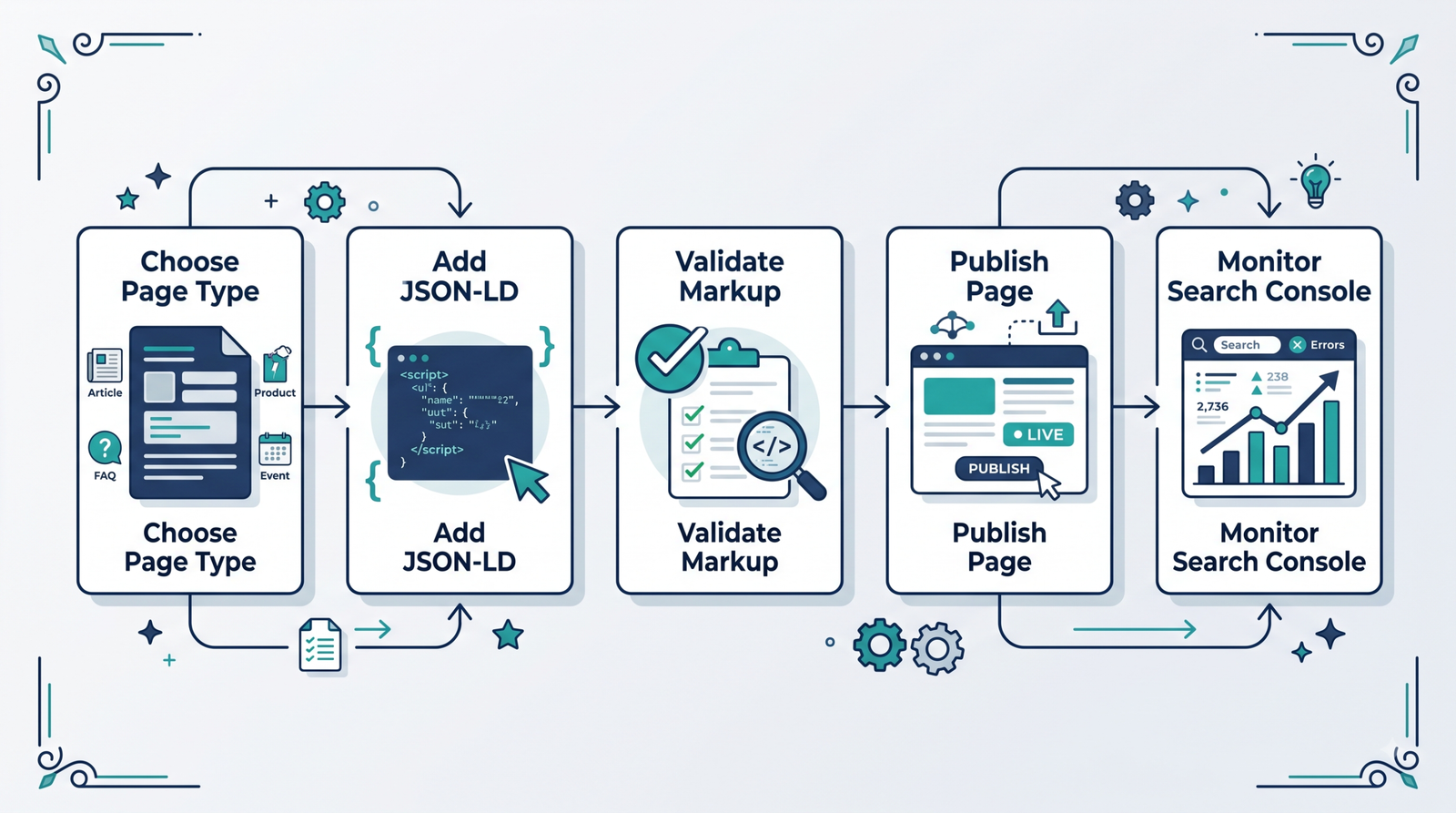
A Step-by-Step Process for Adding Schema Markup
- Audit your high-value page templates. Identify pages that drive revenue, qualified leads, or sustained organic traffic. Common starting points include product pages, articles, recipes, event pages, category pages, and location pages.
- Choose the appropriate structured data type. Review Google’s current Search Gallery documentation to see supported formats and required properties.
- Confirm that the information is visible and accurate. Mark up facts that visitors can find on the page. Do not add ratings, prices, FAQs, offers, or other details that are hidden, misleading, outdated, or unsupported.
- Use JSON-LD where practical. Add code through your CMS, SEO plugin, ecommerce platform, tag management workflow where appropriate, or custom development process.
- Include required properties first. Recommended properties can improve completeness, but required fields are the first priority for eligibility.
- Test before publishing. Use Google’s Rich Results Test to check eligible rich result types and diagnose errors.
- Deploy carefully and inspect the live URL. Confirm that the markup appears on the published page and that it matches the rendered content.
- Monitor Google Search Console. Review enhancement reports, warnings, and errors after Google crawls the updated pages.
- Maintain the markup. Recheck templates after redesigns, plugin updates, product feed changes, or major content revisions.
How to Test and Validate Structured Data
Validation is not optional. A page can contain JSON-LD and still have syntax errors, missing required values, incorrect URLs, unsupported fields, or mismatches with visible content.
Use Google’s Rich Results Test
The Rich Results Test checks whether a URL or code sample is eligible for Google-supported rich result types. It can flag critical errors and identify valid items. A successful test means Google can read the relevant markup; it does not guarantee that Google will show a rich result.
Use Schema Markup Validator for broader Schema.org checks
The Schema Markup Validator can help inspect Schema.org structured data more broadly. This can be helpful for markup that is useful for semantic meaning but is not tied to a Google rich result feature.
Monitor Search Console after launch
Google Search Console can show structured data enhancement reports for supported types detected on your site. These reports are useful for finding template-level problems affecting many URLs. Prioritize errors first, then assess warnings based on their relevance to your implementation.
Common Schema Markup Mistakes to Avoid
- Marking up content that is not visible to users. Structured data should represent the main content of the page, not hidden promotional claims or unrelated information.
- Using inaccurate product prices or availability. This often happens when markup is manually maintained while inventory data changes elsewhere.
- Adding review markup without genuine reviews. Ratings and reviews must reflect real, properly displayed review content and follow Google’s applicable guidelines.
- Applying the wrong schema type. A generic blog post is not a recipe, product, or event simply because those formats may have enhanced results.
- Duplicating conflicting markup. Multiple plugins, themes, and ecommerce tools may each output structured data. Conflicting values can confuse crawlers and complicate troubleshooting.
- Ignoring template changes. A redesign can quietly remove images, dates, prices, or other data that your markup depends on.
- Expecting FAQ markup to produce FAQ rich results for every site. Google significantly limited FAQ rich results in 2023. At present, they are generally reserved for well-known, authoritative government and health websites. Other websites may still use FAQPage markup when it accurately describes content, but should not expect a visible FAQ enhancement in Google Search.
Schema Markup Checklist for Website Owners
- □ Identify the pages that matter most for search visibility or conversions.
- □ Match each page to a relevant Google-supported structured data type.
- □ Make sure marked-up information is visible, accurate, current, and useful.
- □ Use JSON-LD unless there is a strong reason to use another format.
- □ Include required properties and relevant recommended properties.
- □ Check for duplicate or conflicting markup from plugins and themes.
- □ Test representative URLs before a sitewide rollout.
- □ Monitor Search Console for detected items, warnings, and errors.
- □ Revalidate after major CMS, plugin, template, or catalog updates.
- □ Treat rich result visibility as an opportunity, not a guarantee.
Should You Use a Plugin, a Generator, or Custom Code?
The right implementation method depends on your site and the complexity of your data.
Plugins are convenient for many WordPress sites. They can automatically generate basic Article, Organization, Breadcrumb, and other markup. Before relying on one, check what your theme and other SEO tools already produce to avoid duplication.
Schema generators can be useful for small sites or one-off pages. They help create JSON-LD code, but the site owner remains responsible for ensuring the output is accurate and stays updated.
Custom code is often best for large publishers, ecommerce stores, directories, marketplaces, and websites with complex templates. A developer can connect markup directly to the content management system or product database, reducing manual work and helping keep data synchronized.
How to Measure the Value of Schema Markup
Do not judge schema markup only by whether you see a rich result during a manual Google search. Search results are personalized and can vary by device, location, query, and time.
Instead, track relevant metrics over a meaningful period:
- Valid structured data items and errors in Search Console
- Organic impressions for relevant pages and queries
- Organic clicks and click-through rate trends
- Rankings or average position as contextual data, not the only KPI
- Revenue, leads, engagement, or other business outcomes from organic visitors
Compare performance cautiously. Search demand, seasonality, algorithm updates, content changes, and competitor activity can all affect results. The most reliable approach is to document when markup was deployed and watch trends across a group of similar pages.
Frequently Asked Questions About Schema Markup
Does schema markup improve Google rankings?
Schema markup is not a direct ranking guarantee. It helps Google understand page content and can make pages eligible for certain rich results. Any performance benefit is indirect and depends on the query, page quality, competition, and whether Google chooses to show an enhanced result.
Is schema markup worth it for a small business website?
It can be worthwhile when the site has clear, accurate business information and important page templates. Start with practical basics such as Organization or LocalBusiness information, Breadcrumb markup, and relevant page-level markup. Focus first on website quality, useful content, and accurate business details.
What is the best schema markup format for SEO?
JSON-LD is usually the preferred format because Google generally recommends it and it is easier to manage in many CMS workflows. Microdata and RDFa can also work when implemented correctly.
Can I add more than one schema type to a page?
Yes. A page can contain multiple relevant types of structured data. For example, an article page may include Article, BreadcrumbList, Organization, and VideoObject markup if all of those accurately describe content on the page. Avoid adding unrelated types or conflicting data.
How long does it take for schema markup to work?
Google must crawl and process the updated page before it can use the markup. Timing varies by website and crawl activity. Even after Google detects valid markup, there is no fixed timeline or guarantee for rich result display.
Can schema markup hurt SEO?
Accurate, guideline-compliant structured data is not inherently harmful. However, misleading, spammy, broken, or conflicting markup can create errors and may make a page ineligible for search features. Poor implementation also consumes time that could be spent improving more important SEO issues.
Conclusion: Use Schema Markup as a Quality Signal, Not a Shortcut
Schema markup is a practical way to give search engines clearer information about your content. For publishers, it can clarify article details and site structure. For ecommerce businesses, it can communicate product information. For local businesses, it can strengthen entity consistency across the web.
The best schema markup strategy is selective, accurate, and maintainable. Begin with high-value page types, use the structured data formats Google currently supports, ensure every marked-up detail appears on the page, test before launch, and monitor results in Search Console.
Most importantly, remember that structured data works alongside—not instead of—helpful content, sound technical SEO, trustworthy business information, and a good user experience. When those fundamentals are in place, schema markup can be a meaningful addition to your SEO and publisher growth strategy.










Leave a Reply