

Email Marketing Strategy Guide: How to Build, Use, and Measure Email the Right Way
Email marketing is one of the most practical ways to build a direct relationship with people who have chosen to hear from your business, publication, or brand. Unlike social media reach, which can change with an algorithm update, an email list gives you a permission-based channel for sharing useful content, product information, promotions, updates, and follow-up messages.
However, sending emails is not the same as having an effective email marketing strategy. Strong programs are built around consent, relevance, timing, clear goals, and measurement. The goal is not to send more messages. It is to send messages that subscribers find useful enough to open, read, click, and continue receiving.
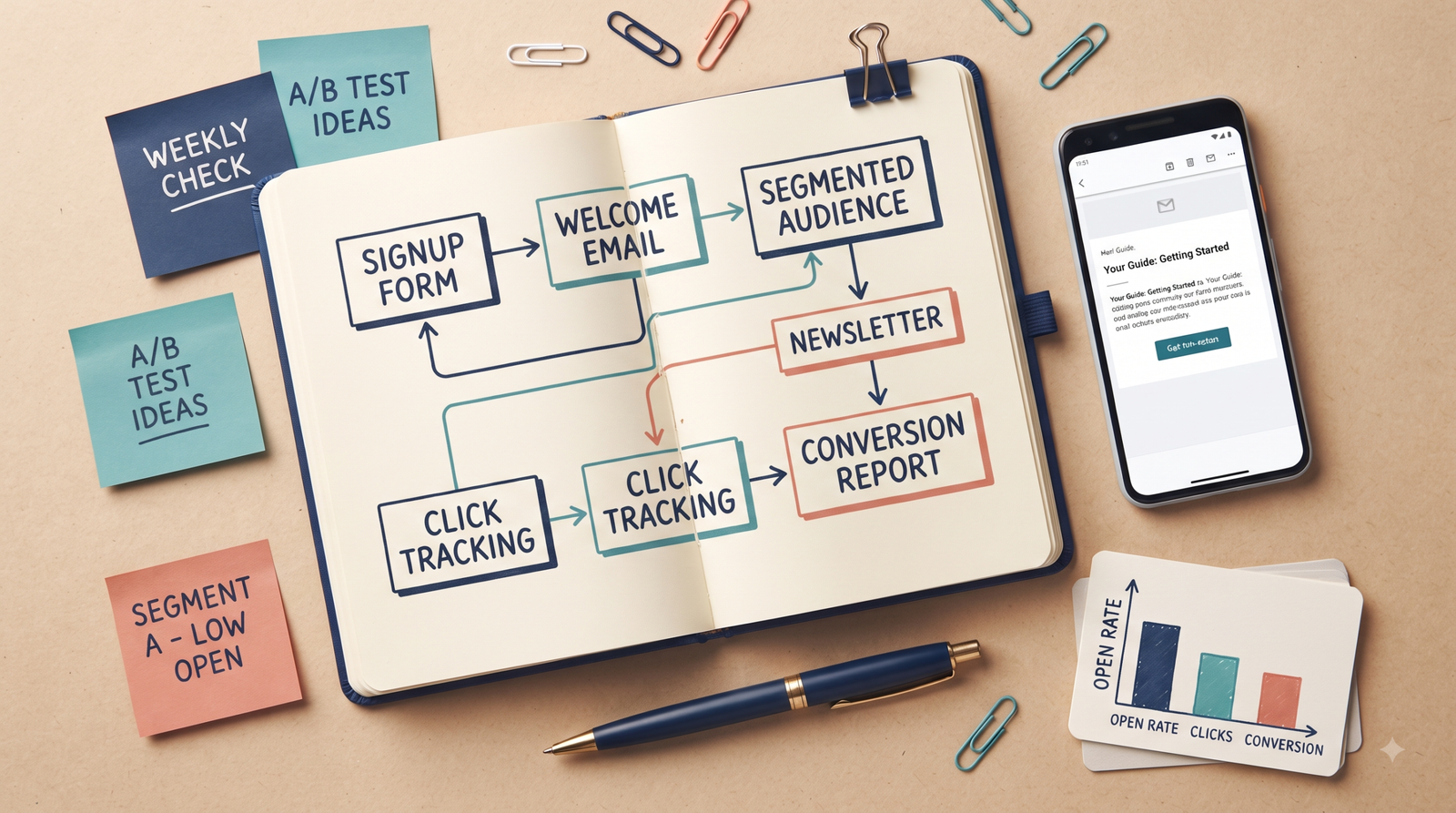
A simple workflow helps turn email marketing from an occasional broadcast into a measurable audience-growth system.
This guide explains how email marketing works, how to build a healthy list, what campaigns to send, how to improve deliverability, and which metrics matter most. It is designed for small businesses, publishers, creators, ecommerce teams, B2B marketers, and anyone building a sustainable digital marketing program.
What Is Email Marketing?
Email marketing is the use of email to communicate with people who have opted in to receive messages from an organization. Those messages may educate subscribers, promote products, deliver editorial content, nurture leads, support customers, or encourage repeat visits and purchases.
A useful email program is not simply a digital flyer. It is a system for providing relevant information at the right stage of a subscriber’s relationship with your brand. For example, a new newsletter subscriber may need a welcome email and helpful introductory content, while an existing customer may benefit more from product education, order updates, or replenishment reminders.
Email works particularly well because it can support many business goals at once:
- Welcome new subscribers and explain what they can expect.
- Turn website visitors into returning readers or customers.
- Nurture leads who are researching a service or considering a purchase.
- Share new articles, videos, guides, event information, or product launches.
- Support customer retention with useful post-purchase communication.
- Re-engage subscribers who have not interacted with your brand recently.
- Build a more resilient audience channel alongside SEO, paid media, and social platforms.
For publishers and content-driven websites, email can be especially valuable. A visitor who finds one article through search may never return unless given a clear reason to subscribe. A well-run newsletter creates that reason by consistently delivering useful, original content.
Why Email Marketing Still Matters
People use many digital channels, but email remains a common place for personal, professional, and transactional communication. It gives brands a way to reach subscribers directly without depending entirely on a feed-based platform or paid advertising auction.
That does not mean every email will reach every inbox. Inbox providers use sophisticated filtering systems, and subscribers can ignore, unsubscribe from, or report messages they dislike. That is why the quality of the relationship matters more than the size of the list alone.
The main advantage of email marketing is that it can be both personal and measurable. You can tailor messages by subscriber interest, customer status, location, behavior, or stage in the buying journey. You can also measure clicks, website activity, conversions, unsubscribe patterns, and other signals that help you improve future campaigns.
Benefits and limitations of email marketing
| Benefits | Limitations and risks |
|---|---|
| Permission-based audience: You can communicate with people who requested updates. | Deliverability challenges: Poor sending practices can reduce inbox placement. |
| Flexible formats: Email supports newsletters, promotions, onboarding, education, and lifecycle messaging. | List fatigue: Too many irrelevant messages can cause unsubscribes and complaints. |
| Segmentation: Different groups can receive more relevant content. | Compliance responsibilities: Marketing emails must follow applicable privacy and anti-spam requirements. |
| Measurable activity: Clicks, conversions, and engagement can guide improvements. | Attribution complexity: Email may influence a conversion without receiving final-click credit. |
| Audience retention: It can bring visitors and customers back over time. | Creative effort: Valuable content, sound design, and testing require consistent work. |
Start With a Clear Email Marketing Strategy
Before choosing a platform or designing a template, decide why someone should subscribe and what your organization wants email to accomplish. A vague goal such as “grow the newsletter” is not enough. A stronger goal identifies the audience, value proposition, desired action, and measurement method.
For example:
- A publisher may aim to increase returning readers by sending a weekly digest of original articles.
- An ecommerce store may aim to improve repeat purchases with welcome, post-purchase, and replenishment email flows.
- A B2B business may aim to qualify leads by offering useful guides and follow-up emails tied to a service category.
- A local service provider may aim to turn inquiries into appointments with educational content and clear booking links.
Define your email program in one sentence
Use this simple framework:
We help [audience] by sending [type of content] at [frequency] so they can [benefit or outcome].
For instance: “We help independent publishers by sending a weekly roundup of practical audience-growth ideas so they can improve traffic and reader retention.”
If you cannot explain the value of subscribing in a sentence, it will be difficult to write an effective signup form, welcome email, or content calendar.
Set realistic objectives
Your goals should connect to real business outcomes, not only vanity metrics. Depending on your organization, useful objectives may include:
- Growing qualified subscribers through voluntary website signups.
- Increasing traffic to important evergreen articles or product pages.
- Generating consultations, demo requests, registrations, or purchases.
- Improving customer onboarding and reducing avoidable support questions.
- Increasing repeat purchases, subscriptions, or renewal activity.
- Re-engaging inactive but still interested subscribers.
Choose one primary objective for each campaign. A single email can contain more than one link, but it should have one obvious next step. When an email asks readers to browse a sale, read three articles, watch a video, complete a survey, and book a call, many will do none of those things.
Build an Email List the Right Way
The foundation of email marketing is permission. Build your list through clear, voluntary signup methods rather than purchased lists, scraped addresses, or automatic enrollment without meaningful notice. A smaller list of interested subscribers is usually more valuable than a large list of people who never asked to hear from you.
For U.S. commercial email, the Federal Trade Commission enforces the CAN-SPAM Act. Requirements can depend on the message and circumstances, but commercial email generally needs accurate sender information, a non-deceptive subject line, a valid physical postal address, and a clear way to opt out. Privacy rules and consent expectations may also vary by state, audience location, industry, and the tools you use. Review current official guidance and obtain qualified legal advice when necessary.
High-quality ways to grow your list
- Newsletter forms: Place clear signup forms on relevant articles, resource pages, your homepage, and footer.
- Content upgrades: Offer an optional checklist, template, calculator, guide, or downloadable resource that directly supports the page topic.
- Checkout or account signup: Give customers the choice to receive marketing messages separately from essential transactional updates.
- Webinars and events: Ask attendees to opt in for related follow-up communication.
- Lead forms: Use clear language about what subscribers will receive and how often.
- Referral programs: Encourage existing readers to share a genuinely useful newsletter with others.
Avoid using misleading incentives or hiding marketing consent in dense form language. Your signup form should make it easy for someone to understand what they are joining.
What a good signup form includes
- A specific value proposition, such as “Weekly practical ecommerce growth tips.”
- A clear description of expected content and approximate frequency.
- A simple email field, plus only the additional fields you truly need.
- A link to your privacy policy.
- A visible consent option where appropriate for your audience and use case.
- Accessible labels, readable contrast, and a mobile-friendly design.
Consider using confirmed opt-in, sometimes called double opt-in, when list quality is more important than rapid growth. This process asks a subscriber to confirm their email address after signing up. It may reduce the number of new subscribers slightly, but it can help verify that the address belongs to someone who wants your messages.
Segment Subscribers Before You Need To
Segmentation means dividing subscribers into groups so they receive more relevant messages. You do not need dozens of complex segments at the start. Begin with a few meaningful groups, then add detail when your data and content strategy justify it.
Useful starting segments include:
- New subscribers who have not yet received an introduction to your brand.
- Active readers who regularly click newsletter content.
- Customers and non-customers.
- Leads at different stages, such as early research, evaluation, and ready to speak with sales.
- Subscribers interested in particular content categories or product lines.
- Inactive subscribers who have not clicked or engaged over a defined period.
- Location-based groups when geography is relevant to offers, events, or service availability.
Use segmentation responsibly. Do not collect sensitive personal information unless you have a clear, legitimate reason, proper safeguards, and an appropriate privacy framework. Keep only the data needed to make your communications useful.
Choose the Right Types of Email Campaigns
A complete email marketing strategy usually combines one-time campaigns with automated messages. Campaigns are sent at a chosen time, while automations are triggered by a subscriber action, status, or timing rule.
Core email campaigns to consider
| Email type | Purpose | Best practice |
|---|---|---|
| Welcome email | Introduce your value, set expectations, and guide the first action. | Send promptly after signup and deliver the benefit promised on the form. |
| Newsletter | Share recurring editorial, company, or industry updates. | Prioritize useful content over a long list of unrelated links. |
| Educational sequence | Help leads understand a problem, method, or product category. | Teach before selling and organize messages in a logical order. |
| Promotional campaign | Announce an offer, launch, sale, or limited-time opportunity. | Be clear about terms, timing, pricing, and eligibility. |
| Post-purchase email | Help customers use, maintain, or get more value from a purchase. | Focus on success, not immediately pushing another sale. |
| Re-engagement campaign | Reconnect with inactive subscribers or ask whether they want to remain subscribed. | Use a clear preference update or unsubscribe option. |
| Abandoned cart or browse follow-up | Remind shoppers about a product or unfinished purchase. | Use only where appropriate, expected, and compliant with your policies. |
Build a simple welcome sequence
A welcome sequence is often the best automation to create first because a new subscriber has just expressed interest. A simple three-email sequence can work well:
- Email 1: Deliver the promise. Thank the subscriber, provide the requested resource if applicable, and explain what they will receive next.
- Email 2: Offer immediate value. Share your best guide, most useful tips, or a concise explanation of how you solve the subscriber’s problem.
- Email 3: Encourage a relevant next step. Invite the reader to explore a product category, book a consultation, read a cornerstone article, or set email preferences.
Keep the sequence consistent with the signup source. Someone who joined through an article about publisher growth should not receive an unrelated sequence about a completely different service.
How to Write Better Marketing Emails
Good email copy is direct, useful, and easy to scan. Subscribers are usually reading on a mobile device, often while distracted. Make the purpose clear quickly, then provide enough detail for them to decide whether to take action.
Write honest subject lines
Your subject line should accurately reflect the email content. Avoid misleading urgency, exaggerated claims, or fake reply-style wording. These tactics may create short-term curiosity, but they can weaken trust and increase complaints.
Useful subject line approaches include:
- A specific benefit: “A simple checklist for cleaner email reporting”
- A timely update: “What changed in this week’s newsletter”
- A practical question: “Is your welcome email doing enough?”
- A clear announcement: “New guide: building a permission-based audience”
- A relevant reminder: “Your registration closes tomorrow”
Preview text should add context instead of repeating the subject line word for word.
Use a clear email structure
- Opening: State why the reader should care.
- Value: Deliver a useful insight, update, offer, or resource.
- Primary call to action: Tell readers exactly what to do next.
- Supporting details: Include essential terms, dates, or clarifications.
- Footer: Include sender identification, required information, and unsubscribe access.
Use short paragraphs, descriptive link text, and buttons that explain the destination. “Read the email deliverability checklist” is clearer than “Click here.”
Email design and accessibility checklist
- Use a responsive template that works on mobile screens.
- Keep the main message visible without relying on images alone.
- Add meaningful alt text to informative images.
- Use readable font sizes and sufficient color contrast.
- Make buttons large enough to tap comfortably on a phone.
- Test links, forms, images, and landing pages before sending.
- Use a recognizable sender name and monitored reply address when possible.
- Provide a plain-text version for compatibility and accessibility.
Protect Deliverability and Subscriber Trust
Deliverability refers to whether your messages successfully reach recipients and, more specifically, whether they are placed in the inbox rather than filtered elsewhere. No sender can guarantee inbox placement. It depends on many factors, including recipient engagement, list quality, sending patterns, content, authentication, and the receiving mailbox provider’s systems.
Major mailbox providers publish requirements and recommendations for bulk senders. These can change, so review current guidance from providers such as Google and Yahoo if you send high volumes. Common best practices include authenticating your sending domain, maintaining low complaint rates, honoring unsubscribes promptly, and sending wanted mail.
Deliverability best practices
- Authenticate your domain: Work with your email platform or technical team to configure standards such as SPF, DKIM, and DMARC appropriately.
- Do not buy email lists: Purchased contacts are unlikely to expect your messages and can harm engagement and reputation.
- Remove hard bounces: Suppress addresses that permanently fail delivery.
- Honor opt-outs: Make unsubscribing easy and process requests reliably.
- Send consistently: Sudden, irregular spikes can create operational and reputation problems.
- Warm up new sending infrastructure carefully: Increase volume gradually when launching a new domain or platform.
- Monitor complaints and inactivity: Reassess messages that generate negative signals.
- Match content to expectations: Send what subscribers believed they signed up to receive.
Do not treat every inactive subscriber as a failure. Some people may read an email without clicking, and privacy features can make engagement data incomplete. Still, a large group of long-term non-engagers can be a signal to adjust frequency, content, segmentation, or your re-engagement process.
Measure Email Marketing Performance Correctly
Email measurement should connect campaign activity to meaningful outcomes. Open rates can provide directional information, but they should not be your only success metric. Privacy protections and email client behavior can make opens less precise than they once were.
Instead, look at a group of metrics together and compare performance over time, by segment, and by campaign type.
Essential email marketing metrics
| Metric | What it tells you | How to use it |
|---|---|---|
| Delivery rate | The share of emails accepted for delivery compared with emails sent. | Watch for sudden declines that may indicate list or technical issues. |
| Bounce rate | The share of messages that could not be delivered. | Separate temporary soft bounces from permanent hard bounces. |
| Open rate | A reported signal that an email may have been opened. | Use cautiously as a directional trend, not a precise measure of readership. |
| Click-through rate | The share of delivered emails that generated at least one click. | Evaluate content relevance, calls to action, and link placement. |
| Click-to-open rate | Clicks relative to reported opens. | Use as one indicator of how compelling the email content was for openers. |
| Conversion rate | The share of recipients or clickers who completed the desired action. | Track purchases, signups, downloads, appointments, or other goal completions. |
| Unsubscribe rate | The share of recipients who opted out after a send. | Review frequency, relevance, targeting, and expectations when it rises. |
| Spam complaint rate | The share of recipients who marked the message as spam. | Treat complaints seriously; they can affect sender reputation and inbox placement. |
Use campaign tracking thoughtfully
Add consistent tracking parameters to links when appropriate so your web analytics platform can identify email traffic. Use a naming convention that makes reports understandable, such as campaign type, audience segment, and date or promotion name. Avoid creating dozens of inconsistent labels that make analysis harder.
For example, you might compare whether a weekly editorial newsletter drives more engaged sessions than a promotional email, or whether new subscribers who complete a welcome sequence are more likely to return to the site within 30 days.
Remember that attribution is not perfect. A subscriber might read an email, visit later through a search engine, and convert on another device. Use analytics to inform decisions, but do not assume one metric tells the full story.
Create a Practical Testing Process
Testing helps you improve your email marketing strategy without relying on assumptions. Test one meaningful variable at a time whenever possible, use a sufficiently similar audience, and measure results against the campaign’s real objective.
Potential tests include:
- Subject line clarity versus curiosity.
- Different send times or days for the same audience.
- One primary call to action versus several content links.
- Short-form copy versus a more detailed explanation.
- Text-focused design versus image-heavy design.
- Different signup form placements or value propositions.
- Personalized recommendations versus a general newsletter format.
Do not declare a winner based on a tiny difference or a single campaign. Look for repeatable patterns. If a segment consistently clicks practical guides more than promotional announcements, that insight can shape your editorial calendar and future offers.
Email Marketing, SEO, PPC, and Publisher Growth
Email marketing works best as part of a broader digital marketing system. It does not replace search engine optimization, paid advertising, social media, or content marketing. Instead, each channel can support a different stage of the audience journey.
| Channel | Primary strength | How email supports it |
|---|---|---|
| SEO | Long-term discovery through useful search-focused content. | Encourages search visitors to subscribe and return for related content. |
| PPC | Fast testing and demand capture for targeted offers. | Nurtures leads who are not ready to convert immediately. |
| Content marketing | Education, trust building, and audience development. | Distributes new and evergreen content to interested readers. |
| Social media | Awareness, conversation, and broad reach. | Provides a stable follow-up channel for people who want more depth. |
| SMS or push notifications | Time-sensitive updates with explicit permission. | Can complement email for urgent messages without replacing detailed content. |
For publishers, the most sustainable approach is usually editorial value first and monetization second. A newsletter that regularly helps readers discover useful reporting, analysis, guides, or resources has a stronger long-term reason to exist than one made up entirely of sales messages.
Common Email Marketing Mistakes to Avoid
- Sending without clear permission: This damages trust and can create compliance and deliverability problems.
- Buying or scraping lists: These contacts did not ask for your messages and are unlikely to engage positively.
- Using misleading subject lines: Short-term opens are not worth long-term subscriber distrust.
- Ignoring mobile users: Many subscribers will view your email on a small screen.
- Sending every subscriber the same message: Basic segmentation can greatly improve relevance.
- Overloading one email: Too many offers and calls to action create confusion.
- Measuring opens only: Prioritize clicks, conversions, unsubscribes, complaints, and downstream engagement.
- Forgetting the landing page: An email campaign cannot perform well if the destination is slow, broken, irrelevant, or difficult to use.
- Neglecting inactive subscribers: Use re-engagement and suppression practices to protect list quality.
- Skipping testing: Even small improvements in relevance and usability can compound over time.
Email Marketing Strategy Checklist
- Define the audience and the specific reason they should subscribe.
- Use clear, voluntary signup forms with accurate expectations.
- Document your privacy, consent, and unsubscribe processes.
- Set up an identifiable sender name, reply address, and branded sending domain.
- Configure appropriate email authentication with technical support if needed.
- Create a welcome email or short welcome sequence.
- Choose a realistic publishing and sending cadence.
- Segment new subscribers, customers, active users, and inactive users.
- Give every campaign one primary objective and call to action.
- Test email rendering, links, and landing pages before sending.
- Track delivery, clicks, conversions, unsubscribes, and complaints.
- Review results regularly and improve based on evidence, not assumptions.
Frequently Asked Questions About Email Marketing
Is email marketing still effective?
Yes. Email marketing can be effective when people have willingly subscribed and the messages are relevant, useful, and sent at a reasonable frequency. It is particularly useful for retention, lead nurturing, customer education, and bringing readers back to a website.
What is the best email marketing frequency?
There is no universal ideal frequency. It depends on what subscribers expect, how much useful content you can provide, and the type of business you run. A weekly publisher newsletter may be appropriate, while a promotional retailer may send more often during a sale period. Set expectations at signup and monitor engagement, unsubscribes, and complaints.
Should I use double opt-in?
Double opt-in can help verify addresses and improve list quality, especially for newsletters and content-driven programs. Whether it is the right choice depends on your growth goals, audience, risk tolerance, and applicable requirements. It is often a good option when long-term engagement matters more than maximizing raw signup volume.
What matters more: opens or clicks?
Clicks usually provide a more actionable signal because they show that a recipient took a measurable next step. Opens can still be useful as a broad trend, but privacy features and email client behavior can make them less reliable as a precise performance measure.
How do I improve email deliverability?
Build a permission-based list, send expected content, authenticate your sending domain, remove hard bounces, honor unsubscribes, monitor complaints, and avoid sudden large volume increases. Deliverability is ongoing work rather than a one-time setting.
Conclusion: Build Email Around Trust and Usefulness
The best email marketing strategy is built on a simple principle: respect the subscriber’s attention. Ask for permission clearly, make a credible promise, deliver useful messages, and provide an easy way to leave. Then measure what happens and improve the program over time.
When email is treated as a relationship channel rather than a broadcast tool, it can support audience growth, customer retention, lead nurturing, content distribution, and revenue. Start with a clear value proposition, a clean list, a useful welcome experience, and a small set of meaningful metrics. Those fundamentals will do more for long-term performance than flashy templates or aggressive sending schedules.
Sources and Further Reading
- Federal Trade Commission: CAN-SPAM Act Compliance Guide for Business
- Google Workspace Admin Help: Email sender guidelines
- Yahoo Sender Hub
Editorial note: Email platform features, mailbox-provider requirements, privacy expectations, and legal obligations can change. Verify current requirements with official sources and seek professional advice for legal or compliance questions specific to your organization.










Leave a Reply