

Search Arbitrage Explained: RSOC, AFS, Yahoo, Bing, and How the Business Model Works
Search arbitrage is a paid-traffic publishing model. A publisher buys visitors from an advertising channel, gives those visitors a relevant content and search experience, and aims to earn more from eligible downstream search-ad activity than it spent to acquire the visitors.
In simple terms, the model is:
A sustainable search arbitrage workflow depends on relevant content, voluntary user actions, approved monetization, and accurate margin tracking.
Profit or loss = net search revenue − traffic acquisition cost − operating costs.
The concept is easy to describe, but operating it responsibly is not easy. Legitimate search arbitrage depends on approved search monetization access, useful landing-page content, genuine user intent, accurate attribution, compliant ad creatives, and enough margin to withstand reporting delays, invalid-traffic adjustments, and changing auction prices.
This guide explains the key terms behind search arbitrage, including Google AdSense for Search (AFS), Related Search on Content (RSOC), Yahoo Partner Ads, Bing and Microsoft-powered search inventory, feed providers, economics, and policy risks.
What Is Search Arbitrage?
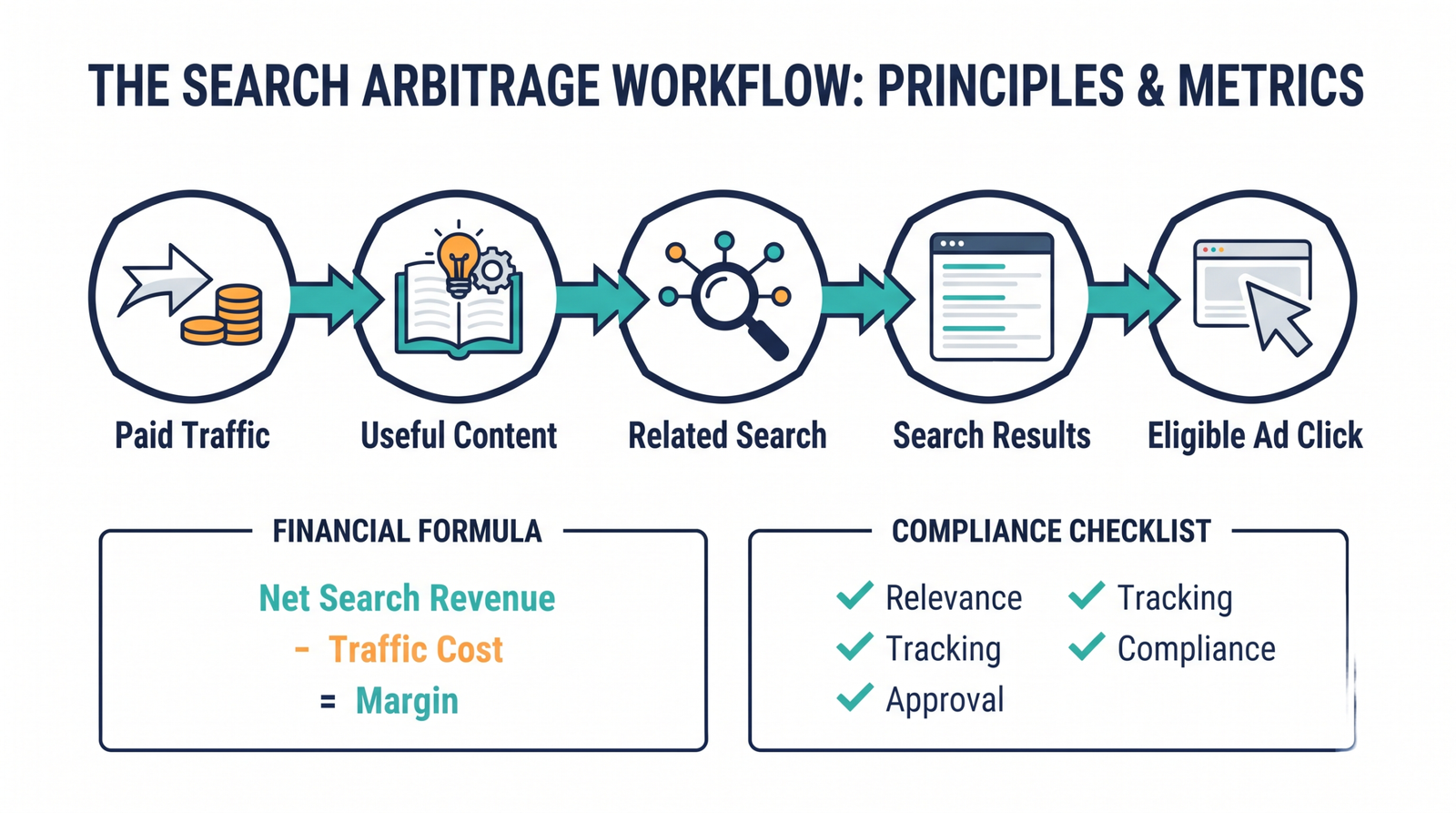
Search arbitrage is a form of performance publishing in which a business purchases traffic and attempts to monetize qualified user activity later in the visit. The monetization event is typically a click on a sponsored result displayed on a search-results page.
It is important to understand what search arbitrage is not. A publisher is not simply buying a search-ad click and reselling that same click. A typical journey has several separate stages:
- A person sees an ad, native recommendation, social post, or other paid placement.
- The person voluntarily clicks and visits a publisher’s content page.
- The page delivers content relevant to the message that brought the person there.
- The visitor may enter a search query or select a relevant related-search term.
- The visitor reaches a search-results page with sponsored search ads and, depending on the product, other results.
- The visitor may click an eligible sponsored result.
- The search provider records the event and later calculates the publisher’s share under the applicable agreement.
A visit, a related-search click, or a submitted search does not automatically produce revenue. In most search monetization arrangements, the meaningful revenue event occurs only when an eligible user clicks a sponsored search advertisement. Revenue may also be subject to quality review, invalid-traffic filtering, contractual deductions, and reporting adjustments.
Why Search Arbitrage Is Harder Than It Looks
Search arbitrage has a narrow operating margin. Traffic costs can rise quickly, while search-ad revenue varies by topic, country, device, query quality, advertiser demand, and user behavior. A campaign that looks profitable in a short reporting window can become unprofitable after delayed revenue, traffic-quality reviews, or changes in media-buying costs.
Successful operators generally treat it as a publishing and analytics business rather than a shortcut to advertising revenue. They invest in useful pages, transparent user journeys, source-level measurement, and policy controls. They also stop or reduce campaigns when quality deteriorates instead of attempting to force more clicks.
Core Search Arbitrage Terms
- Search feed
- An industry term for the technology and commercial relationship that supplies search ads, search results, related-query functionality, reporting, and payments. The precise product and rights vary by provider.
- Feed provider
- A company that provides direct or intermediary access to search monetization technology and commercial arrangements. A provider may manage integration, reporting, payment administration, and policy support.
- Search-results page (SERP)
- The page shown after a user enters or selects a query. It may include sponsored ads, algorithmic results, navigation elements, and disclosures.
- Query monetization
- Generating advertising revenue when a user makes a genuine search query or voluntarily selects a relevant related query and later interacts with eligible sponsored results.
- RSOC
- A common industry abbreviation for Related Search on Content. Google’s current product language commonly refers to this as Related search for content pages.
- AFS
- AdSense for Search, Google’s publisher product for monetizing approved search experiences with Google Search ads.
- Sub-ID
- A tracking parameter used to identify a campaign, ad set, creative, placement, device type, landing page, or other traffic segment in reporting.
- RPC and RPM
- Revenue per click and revenue per thousand impressions or visits. These labels are not universal, so operators should always confirm exactly which clicks, impressions, or visits a dashboard uses in its formula.
How the Search Arbitrage Business Model Works
The model has two financial sides: the publisher pays for traffic and earns search monetization revenue. The difference is the gross campaign margin before payroll, content, technology, fraud prevention, taxes, and other operating expenses.
| Metric | Simple formula | Why it matters |
|---|---|---|
| Traffic cost | Paid clicks × cost per visit | Shows what it costs to bring users to the site. |
| Search revenue | Eligible monetized clicks × net revenue per click | Measures monetization after the user reaches the search experience. |
| Revenue per visit | Net search revenue ÷ paid visits | Useful for comparing traffic sources and landing pages. |
| Gross margin | Net search revenue − traffic cost | Shows whether a campaign can potentially cover overhead. |
| Return on ad spend | Net search revenue ÷ traffic cost | Helps compare campaigns, but should not replace profit analysis. |
For example, if a campaign buys 10,000 visits at an average cost of $0.20, traffic spend is $2,000. If it generates $2,300 in net recognized search revenue, the gross margin is $300 before all other expenses. If later adjustments reduce recognized revenue, that margin can disappear. This example is illustrative only; real rates vary widely and should not be assumed.
The metrics that matter most
- Cost per visit: The actual cost after platform fees, currency conversion, and campaign-level spend are included.
- Landing-page engagement: Whether visitors read or interact with useful content rather than immediately leaving.
- Search initiation rate: The share of visitors who voluntarily use the site search feature or select a genuinely relevant related term.
- Sponsored-result engagement: The downstream behavior that can lead to recognized revenue, subject to provider rules.
- Net revenue per visit: Often more useful than a headline RPC figure because it reflects the whole user journey.
- Adjustment rate: The gap between estimated and finalized earnings, where reporting systems provide both figures.
What Is Google AdSense for Search (AFS)?
Google AdSense for Search, commonly called AFS, is a Google publisher offering for displaying Google Search ads on approved search-results pages. It is designed for publishers that offer a site-search experience and meet Google’s contractual, technical, and policy requirements.
AFS should not be confused with regular display AdSense. Access to AFS is not automatically available simply because a publisher has a standard AdSense account. Google states that interested publishers should work with an account manager, and sites must go through relevant ownership, policy, and product review steps before search ads can serve.
Google has publicly stated that direct AFS publishers receive 51% of the search advertising revenue recognized by Google. That figure should be read carefully: it applies to the relevant direct-publisher arrangement and recognized revenue. A publisher using an intermediary may receive a different net amount after the provider’s commercial terms, fees, deductions, or revenue share are applied.
Standard AFS search
In a standard AFS implementation, a person enters a query into a website’s search box. The resulting page can show search ads related to that query, subject to the implementation and program rules. The search box and results page should provide a clear, usable, user-driven search experience rather than function as a thin bridge to advertisements.
What Is RSOC or Related Search on Content?
RSOC generally means Related Search on Content. Google documentation also uses the terms Related Search on Content and Related search for content pages. It is an AFS feature that shows contextually relevant suggested search terms on an approved content page.
For example, an article about moving to a new apartment might present relevant search suggestions such as “moving checklist” or “renter insurance questions.” If a reader chooses one of those terms, the reader moves to a search-results page, where sponsored search ads may be served under the approved AFS setup.
RSOC is not a separate ad network and is not an alternative to AFS. It is a content-page feature within the broader AFS environment. Google generally needs to crawl the content page to generate related terms, and publishers must complete AFS-related contracting, activation, and implementation review requirements before use.
| Factor | Standard AFS Search | RSOC / Related Search on Content |
|---|---|---|
| Starting action | User types a query into a search box. | User reads content and voluntarily selects a related term. |
| Starting page | A search interface or site-search page. | An approved article or content page. |
| Query source | Direct user input. | Contextually generated suggested query. |
| Results destination | Search-results page. | Search-results page after selecting a related term. |
| Revenue event | Potentially an eligible sponsored-ad click. | Potentially an eligible sponsored-ad click downstream. |
| Key quality requirement | A clear, functional, user-led search experience. | Useful content and relevant, non-misleading related terms. |
A high click-through rate on related terms is not automatically a positive signal. If suggestions are irrelevant, presented in a misleading way, or visually designed to cause accidental clicks, user trust and policy compliance can suffer. Good implementations prioritize relevance and clear interaction choices over maximizing superficial engagement.

Yahoo Partner Ads, Bing, and Microsoft-Powered Search Inventory
Search monetization terminology can be confusing because visible brands, ad demand, technology providers, and commercial contracts do not always align one-to-one.
Yahoo Partner Ads
Yahoo Partner Ads (YPA) is Yahoo’s publisher offering for approved partners that want to monetize search-results pages with Yahoo search ads. Yahoo’s public materials describe options that can include advertisements alone or advertisements combined with algorithmic web results. Publishers typically need to apply and enter into a commercial relationship before deploying the product.
Yahoo does not publicly publish one universal revenue-share percentage for all YPA publishers. Payment timing, deductions, approved traffic, country availability, and monetization terms should be confirmed in the actual agreement rather than inferred from third-party claims.
Bing and Microsoft Advertising inventory
Microsoft Search ads can appear across Microsoft Bing and partner properties. Microsoft Advertising has described its network as including Bing and partner sites, which may include well-known search brands depending on the applicable relationship and market. As a result, a Yahoo-branded search experience may involve Microsoft Advertising demand in some contexts.
That does not mean Yahoo Partner Ads and a generic “Bing feed” are the same product. The publisher integration, ad-serving relationship, reporting, and contract can differ. Likewise, a standard Microsoft Advertising advertiser account is not automatically a self-service publisher search-feed account for search arbitrage.
When a provider uses phrases such as “Yahoo feed,” “Bing feed,” or “Microsoft feed,” ask what the term means operationally. Confirm the underlying product, the party with contractual rights, which inventory is approved, and whether paid traffic and sub-publishing are explicitly permitted.
Search Monetization Product Comparison
| Product or term | Primary role | Typical access route | Revenue-share information |
|---|---|---|---|
| Google AFS | Monetizes approved publisher search-results pages with Google Search ads. | Google review, account manager, contract, and approved sites. | Google has stated 51% of recognized AFS revenue for direct publishers; intermediary arrangements vary. |
| Google RSOC | Moves a content-page reader to a related search experience. | AFS activation plus approved RSOC implementation. | Part of AFS; no separate universal public RSOC share should be assumed. |
| Yahoo Partner Ads | Provides Yahoo search ads, potentially with algorithmic results. | YPA application and contract. | Commercial terms are contract-dependent. |
| Microsoft-powered inventory | Search advertising demand across Bing and partner distribution. | Contracted publisher, syndication, or authorized provider relationship. | Contract-dependent. |
| Third-party feed provider | Intermediary access, technology, reporting, and support. | Provider application, due diligence, and site approval. | Provider-dependent and may include fees, reserves, or a revenue share. |
Direct Feed Access vs. Working With a Feed Provider
Some publishers work directly with a search company. Others use an authorized intermediary or feed provider. Neither route is automatically better; the right choice depends on the publisher’s scale, technical resources, traffic quality, commercial eligibility, and risk tolerance.
Potential advantages of direct access
- Closer communication with the underlying search company.
- Potentially clearer policy interpretation and reporting.
- Fewer commercial layers between recognized revenue and publisher payment.
- More direct control over approved implementation details.
Potential limitations of direct access
- Higher eligibility standards, technical expectations, or volume requirements.
- Longer contracting and review process.
- More internal responsibility for engineering, reporting, compliance, and support.
Potential advantages of a provider
- Integration support and consolidated reporting.
- Help with tracking parameters, landing-page requirements, and operational workflows.
- Potential access for publishers that do not qualify for a direct relationship.
Potential risks of a provider
- An extra revenue-share layer or platform fee.
- Less visibility into gross advertiser revenue and reconciliation.
- Provider-specific restrictions, reserves, deductions, and payment timing.
- Dependence on the provider’s own upstream relationship and account standing.
Questions to Ask Before Choosing a Search Feed Provider
Never assume a provider is authorized because it uses a familiar search brand in its marketing. Request written clarification and review the agreement carefully. Ask these questions before sending paid traffic:
- Which company supplies the underlying search ads?
- Is the provider authorized to offer this product to publishers or sub-publishers?
- Are paid traffic acquisition and search arbitrage expressly permitted?
- Which traffic sources, countries, devices, verticals, and domains are approved?
- Does each new site or landing-page template require review?
- What is the revenue formula: gross revenue, net revenue, RPC, RPM, or another measure?
- Which fees, reserves, clawbacks, invalid-traffic deductions, or adjustments may apply?
- How long is the reporting and payment delay?
- Which Sub-ID dimensions are available for source, creative, placement, and device analysis?
- What happens to outstanding earnings if an account is paused, reviewed, or terminated?
- Who is responsible for policy issues caused by landing pages, traffic sources, or implementation changes?
Compliance and User-Experience Requirements
Search arbitrage can create serious policy risk when user experience is sacrificed for clicks. Search providers, traffic platforms, and advertisers may prohibit or restrict deceptive, low-quality, incentivized, automated, invalid, or misleading traffic. Requirements vary by product and contract, so publishers should treat their signed terms and official product policies as the controlling sources.
As a practical standard, a compliant operation should make every step understandable to a reasonable user. An ad should accurately describe the destination. The landing page should deliver the promised information. Search suggestions should be relevant to the page. Search results should be clearly presented. Sponsored content should be identified as required by the applicable product.
Common warning signs
- Ads that promise one thing but send users to unrelated content.
- Thin pages created mainly to push a related-search click.
- Misleading buttons, fake navigation, false download prompts, or disguised ads.
- Instructions telling users to click advertisements or search terms.
- Incentives, rewards, or compensation for ad-related engagement.
- Bot traffic, click farms, automated browsing, or unexplained traffic spikes.
- Targeting vulnerable users with sensational, deceptive, or unsafe claims.
- Using copyrighted brands, trademarks, or news-like designs in ways that create confusion.
Pre-launch compliance checklist
- Confirm that the domain, page template, geography, and traffic source are approved in writing.
- Make the page useful even if the reader never performs a search or clicks an ad.
- Match the acquisition ad’s claim, targeting, and creative to the landing-page topic.
- Use clear labels and avoid designs that could generate accidental clicks.
- Implement consent, privacy disclosures, and data handling practices appropriate for your audience and vendors.
- Set up fraud detection and block suspicious placements, apps, referrers, and data centers where appropriate.
- Keep source-level records for spend, visits, engagement, and monetization outcomes.
- Test on mobile devices, where crowded layouts and accidental interactions are more likely.
- Obtain approval before materially changing page layouts, traffic sources, or monetization flows.
How to Evaluate a Search Arbitrage Campaign Responsibly
Do not judge a campaign from one dashboard metric or a few hours of data. Evaluate the entire funnel and compare estimated performance with finalized results.
- Start with a narrow test. Limit daily budget, country, device mix, and placements until traffic quality is understood.
- Track the full journey. Use Sub-IDs to connect traffic source, campaign, creative, landing page, and downstream search monetization.
- Measure page quality. Review engagement, scroll behavior, page speed, return visits, and whether the page genuinely answers the visitor’s initial need.
- Reconcile reports. Compare advertising-platform spend, analytics visits, provider reporting, estimated earnings, and finalized payments.
- Segment aggressively. A profitable source can hide unprofitable placements, creatives, devices, or geographies.
- Monitor delayed effects. Pause or reduce campaigns if invalid-traffic indicators, complaint rates, or adjustment rates rise.
- Optimize for value, not forced engagement. Improve content relevance and page usability rather than using manipative design tactics.
Pros and Cons of Search Arbitrage
Potential benefits
- Can diversify publisher revenue beyond display advertising.
- May monetize high-intent searches when the experience is approved and relevant.
- Provides granular data for testing topics, traffic sources, and landing pages.
- Can support useful niche content when economics and compliance align.
Major challenges
- Margins can be thin and volatile.
- Access is contractual and not guaranteed.
- Traffic quality and policy enforcement are ongoing responsibilities.
- Estimated revenue can differ from finalized revenue.
- Payment delays can create cash-flow pressure.
- Poor user experience can damage brands and lead to account action.
Frequently Asked Questions
Is search arbitrage legal?
Buying traffic and monetizing a legitimate publisher search experience is not inherently unlawful. However, legality and platform compliance are different questions. Publishers must comply with contracts, advertising-platform rules, privacy obligations, consumer-protection requirements, and applicable laws in the locations where they operate. Deceptive claims, invalid traffic, misleading interfaces, and unauthorized feed use can create substantial risk.
Is RSOC the same as AFS?
No. AFS is the broader Google AdSense for Search product. RSOC, often called Related search for content pages, is a related-search feature that can be used within an approved AFS implementation to take users from relevant content to search results.
Can anyone open an AFS account?
No. Google does not position AFS as an automatically enabled self-service feature for every AdSense publisher. Access involves review, contracting, approved sites, and product-specific requirements. Eligibility and onboarding processes can change over time.
Do publishers earn money whenever a visitor searches?
Usually no. A search or a click on a related term does not itself guarantee revenue. Revenue generally depends on eligible downstream sponsored-ad activity and is subject to the provider’s reporting, quality controls, and contractual terms.
What is a “Yahoo feed” or “Bing feed”?
These are often informal industry labels rather than precise product names. They may refer to a publisher integration, ad-demand source, search-syndication relationship, or third-party provider arrangement. Always verify the actual product and contractual rights behind the label.
What is the biggest risk in search arbitrage?
The biggest risk is often assuming that a short-term revenue number represents durable profit. Costs, traffic quality, advertiser demand, enforcement actions, and revenue adjustments can all change quickly. Sustainable operations prioritize approved traffic, user value, clear reporting, and conservative financial controls.
Conclusion: Search Arbitrage Requires Real Publisher Discipline
Search arbitrage is best understood as a search monetization and performance-publishing model, not a guaranteed revenue tactic. A publisher acquires visitors, provides useful and relevant content, allows users to make voluntary search choices, and may earn revenue when eligible sponsored search interactions occur.
AFS is Google’s broader search monetization product, while RSOC is its related-search feature for approved content pages. Yahoo Partner Ads and Microsoft-powered search inventory may offer other routes, but product names and visible search brands should never substitute for contract-level verification.
Before spending on traffic, confirm feed authorization, approved sources, payment rules, reporting definitions, and policy requirements. Then test conservatively, measure net revenue rather than headline metrics, and protect user experience at every stage. That approach is slower than chasing click volume, but it is the only responsible foundation for a sustainable search arbitrage business.










Leave a Reply