

Conversion Rate: How to Measure, Improve, and Use It in Digital Marketing
Getting website traffic is only part of digital marketing. The more important question is whether visitors take a meaningful next step after they arrive. Do they make a purchase, request a quote, subscribe to a newsletter, download a resource, call your business, or click through to a partner offer?
Conversion rate measures the percentage of people who complete that desired action. It is one of the most useful metrics for evaluating whether your advertising, content, landing pages, and user experience are producing real business results.
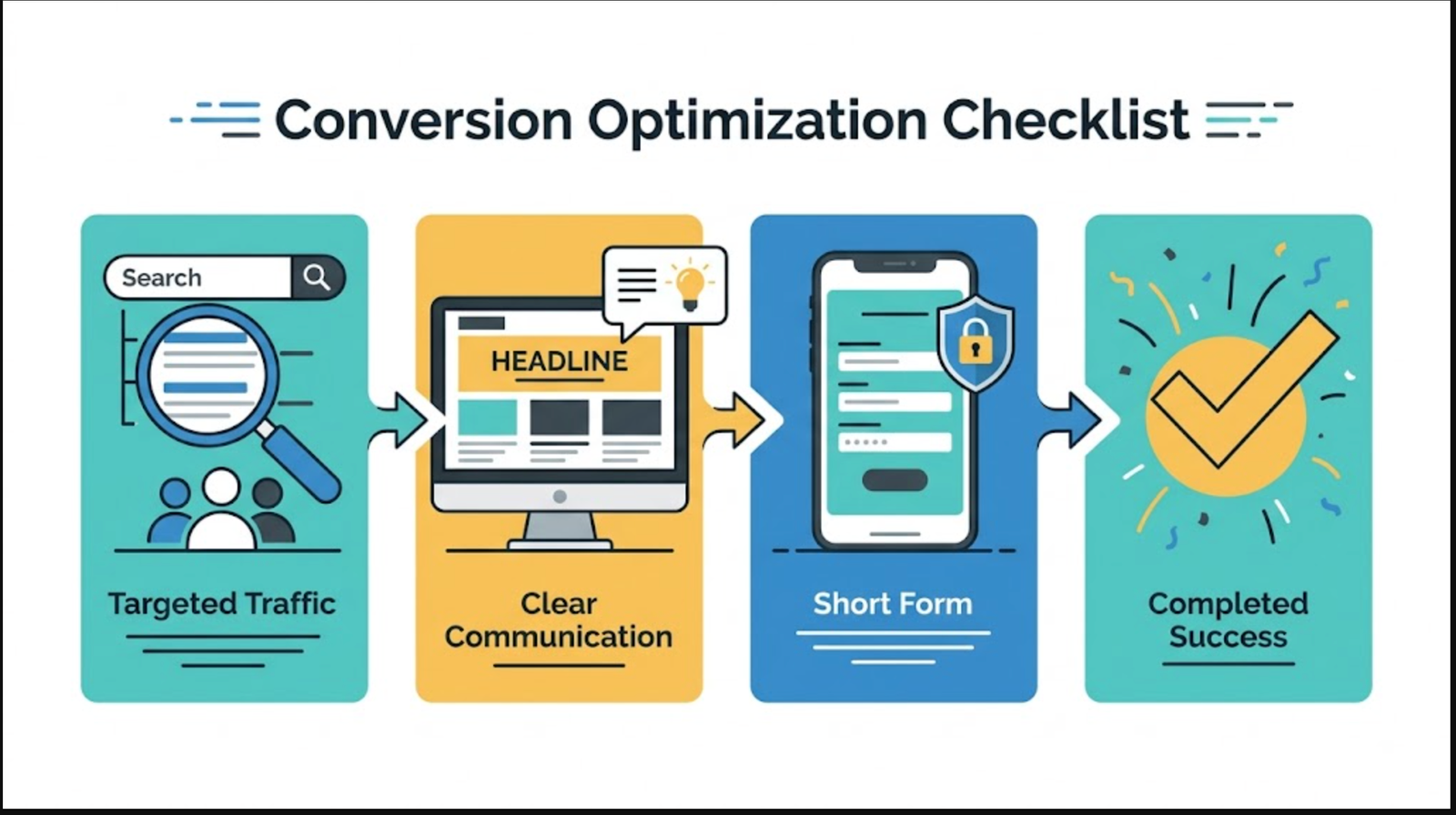
Improving conversion rate usually requires better traffic alignment, clearer messaging, less friction, and reliable measurement.
This guide explains what conversion rate means, how to calculate it correctly, what affects it, and how marketers, publishers, ecommerce teams, and small businesses can improve it without relying on guesswork.
What Is Conversion Rate?
Conversion rate is the percentage of eligible visitors, users, sessions, clicks, or interactions that complete a defined action known as a conversion.
A conversion is not limited to a sale. The right conversion depends on the purpose of the page, campaign, or business model. For example, an online store may count completed purchases as its primary conversion. A local service company may count submitted lead forms or phone calls. A content publisher may count email subscriptions, account registrations, or clicks to a high-value affiliate partner.
In simple terms, conversion rate answers this question:
Of the people who had an opportunity to act, what percentage actually did?
Common examples of conversions
- Completing an ecommerce purchase
- Submitting a contact, quote, or consultation form
- Signing up for an email newsletter
- Creating an account or starting a free trial
- Booking an appointment or reservation
- Calling a business from a mobile device
- Downloading a guide, template, or app
- Clicking an affiliate link or partner referral link
- Watching a key product demonstration or completing an onboarding step
Not every action deserves equal importance. A visitor who opens a navigation menu is behaving differently from someone who buys a product. Good measurement starts by separating minor engagement actions from actions that represent genuine value.
How to Calculate Conversion Rate
The basic conversion rate formula is straightforward:
Conversion Rate = (Number of Conversions ÷ Total Eligible Visitors or Interactions) × 100
For example, if a landing page receives 2,000 visits in one month and 80 visitors submit its lead form, the calculation is:
(80 ÷ 2,000) × 100 = 4%
That page’s conversion rate is 4%.
Conversion rate calculation examples
| Scenario | Conversions | Eligible Total | Conversion Rate |
|---|---|---|---|
| Ecommerce product page | 45 purchases | 1,500 sessions | 3% |
| Lead generation campaign | 30 form submissions | 600 ad clicks | 5% |
| Newsletter signup page | 120 subscribers | 2,400 visitors | 5% |
| Affiliate content page | 75 outbound partner clicks | 1,000 visitors | 7.5% |
The formula is simple, but the denominator matters. A rate based on ad clicks may differ from a rate based on website sessions, unique users, or product page views. Choose one denominator that reflects the opportunity to convert, then use it consistently when comparing performance.
Sessions, users, clicks, and interactions: which denominator should you use?
There is no single denominator that works for every situation. The best option depends on the platform and the question you want to answer.
| Denominator | Best Used For | Important Consideration |
|---|---|---|
| Users | Understanding how many individual people convert | One person can visit several times before converting. |
| Sessions | Website and landing-page analysis | A returning user may create multiple sessions. |
| Ad clicks | Paid search and paid social campaign analysis | Useful for judging click quality and ad-to-page alignment. |
| Product page views | Product-level ecommerce analysis | Helps compare products with different traffic levels. |
| Eligible interactions | Ad platforms and defined conversion events | Definitions can vary by platform and conversion setup. |
For example, a Google Ads conversion rate is generally based on eligible ad interactions, while website analytics reports may calculate a rate from sessions or users. These are both useful, but they should not be treated as identical metrics.
Why Conversion Rate Matters in Digital Marketing
Traffic without outcomes can be expensive. A campaign may generate thousands of visits, but those visits have limited value if the audience does not buy, inquire, subscribe, or take another meaningful action.
Conversion rate helps connect marketing activity to outcomes. It can reveal whether a campaign is attracting the right audience, whether the landing page keeps its promise, and whether the path to conversion is easy enough for visitors to complete.
Conversion rate helps you make better decisions
- Prioritize budget: Invest more confidently in channels that produce qualified outcomes, not merely impressions or clicks.
- Improve landing pages: Identify pages where visitors show interest but encounter unclear messaging or friction.
- Evaluate traffic quality: Find campaigns, keywords, referrals, or content topics that bring better-matched visitors.
- Increase return from existing traffic: Improving conversion rate can create more leads or sales without increasing traffic acquisition costs.
- Understand audience intent: Learn whether visitors are researching, comparing, ready to buy, or simply looking for a quick answer.
For businesses with limited advertising budgets, this metric can be especially valuable. Increasing a page’s ability to convert can sometimes be more cost-effective than continuously buying more traffic.
Conversion Rate by Marketing Channel
The meaning of conversion rate changes somewhat across channels. Each channel has different user expectations, tracking methods, and stages of the buyer journey.
Conversion rate for SEO
In search engine optimization, conversion rate shows whether organic visitors do more than read and leave. A page may rank well and attract substantial search traffic, yet still underperform if its content does not match the visitor’s next need.
For SEO, review conversion rate by landing page, search query theme, device type, geography, and content format. Informational articles may naturally convert differently from product, service, category, or comparison pages. That does not make informational content unimportant; it may support awareness and later conversions. The key is choosing a realistic conversion goal for the page’s intent.
Conversion rate for PPC
For pay-per-click advertising, conversion rate helps assess whether ads are producing useful clicks. A low rate may point to overly broad targeting, weak keyword intent, a mismatch between ad copy and landing page content, or a difficult conversion process.
Paid search campaigns should be reviewed alongside cost per conversion, conversion value, search terms, device performance, and the quality of resulting leads or sales. A campaign with a lower conversion rate can still be worthwhile if its conversions are more valuable or generate stronger long-term customer relationships.
Conversion rate for content marketing and publishers
Content publishers often use multiple conversion points. An article might encourage readers to subscribe, view related content, use a tool, request information, or visit a carefully selected partner. A useful content conversion is one that improves the reader experience or supports a sustainable business model without misleading the audience.
For publishers, avoid measuring success only through ad clicks or outbound clicks. Consider newsletter signups, return visits, engaged sessions, subscriptions, assisted conversions, and revenue per landing page where appropriate. A highly useful article may influence a later conversion rather than creating one immediately.
Conversion rate for ecommerce
Ecommerce conversion rate is typically tied to completed orders, but product pages and checkout steps need their own analysis. A low store-wide rate can hide a specific problem, such as unavailable sizes, unclear shipping information, slow mobile checkout, unexpected fees, or an ineffective product page.
Useful ecommerce funnel metrics include product view-to-cart rate, cart-to-checkout rate, checkout completion rate, average order value, refund rate, and repeat purchase behavior.
What Is a Good Conversion Rate?
There is no universal “good” conversion rate. Benchmarks vary widely based on industry, product price, traffic source, audience location, brand recognition, device mix, offer type, and the amount of effort required from the visitor.
A newsletter signup may have a very different rate from a high-ticket business consultation request. Likewise, a branded search campaign often behaves differently from a campaign targeting people who have never heard of the company.
Instead of chasing a generic benchmark, start with a more useful comparison:
- How does the page perform compared with its own previous period?
- How does one traffic source compare with a similar source?
- How does mobile performance compare with desktop performance?
- Has lead quality or revenue improved along with the rate?
- Did tracking, attribution, pricing, traffic mix, or the offer change?
A meaningful improvement is one that is measured consistently and supports business goals. A higher rate is not automatically better if it results from low-quality leads, aggressive discounting, accidental clicks, or incorrectly configured tracking.
The Difference Between Conversion Rate and Other Important Metrics
Conversion rate is powerful, but it should not be used alone. It describes the share of people who act, not necessarily the profitability or quality of those actions.
| Metric | What It Tells You | Why It Matters Alongside Conversion Rate |
|---|---|---|
| Conversion value | The assigned financial value of conversions | Shows whether conversions are valuable, not just numerous. |
| Cost per conversion | How much it costs to generate one conversion | Helps evaluate paid campaign efficiency. |
| Return on ad spend (ROAS) | Revenue or conversion value generated relative to ad spend | Useful when values are tracked reliably. |
| Average order value | Average revenue from each order | Prevents a focus on volume alone. |
| Lead-to-sale rate | Share of leads that become customers | Helps assess lead quality after form submission. |
| Revenue per visitor | Average revenue generated by each visitor | Combines traffic volume, conversion behavior, and order value. |
| Bounce or engagement metrics | How visitors interact with the page | Can help diagnose relevance and usability issues. |
For example, imagine Campaign A has a 10% conversion rate and Campaign B has a 4% conversion rate. Campaign A may look better at first glance. But if Campaign B produces higher-value orders or leads that close more often, it may deliver better business results.
How to Track Conversion Rate Accurately
Conversion rate optimization is only as reliable as the tracking behind it. If data is incomplete, duplicated, or based on the wrong action, even well-intentioned optimization decisions can lead in the wrong direction.
1. Define the primary conversion for each page or campaign
Choose the action that most closely represents success. For a service landing page, that may be a qualified consultation request. For an ecommerce page, it may be a completed purchase. For an educational article, it may be newsletter registration or a relevant next-page visit.
You can track supporting actions too, but avoid treating every small interaction as equally valuable. A button click is not necessarily a completed lead, and a form start is not the same as a submitted form.
2. Configure tracking tools consistently
Many marketers use Google Analytics, Google Ads conversion tracking, ecommerce platforms, customer relationship management systems, call tracking tools, and tag management systems. The exact setup varies by business, but the goal is the same: record the completed action consistently and connect it to the relevant traffic source where possible.
Test your configuration after publishing changes. Submit a test form, complete a test purchase where practical, or use platform diagnostics to verify events are firing as expected. Review data carefully after major site redesigns, consent banner updates, checkout changes, or tracking migrations.
3. Use an appropriate counting method
Counting choices should match the business goal. For ecommerce, it may be appropriate to count every completed purchase. For lead generation, you may prefer to count one primary lead per ad interaction to avoid overstating results when the same person submits several forms.
Document the counting rule so reporting remains understandable over time. If the rule changes, annotate reports and avoid comparing old and new figures as though nothing changed.
4. Account for conversion delays
Not everyone converts immediately. A visitor may research a product today, return several days later, and then purchase. Longer decision cycles are common for expensive products, B2B services, education, travel, financial services, and other high-consideration purchases.
Recent campaign results can therefore look weaker than they eventually become. Review conversion lag patterns when available, and allow enough time before making major budget or optimization decisions.
5. Protect user privacy and data quality
Use transparent privacy practices and obtain any required permissions for analytics, advertising, and marketing communications. Privacy requirements can vary by location, business type, and technology used, so confirm your implementation with qualified legal and privacy professionals when necessary.
From a measurement standpoint, privacy controls, browser restrictions, cookie settings, and consent choices can affect reporting. Treat analytics data as a useful decision-making signal, not as a perfect record of every customer action.
How to Improve Conversion Rate: 12 Practical Tactics
The best conversion rate optimization work is systematic. Rather than changing everything at once, identify the largest likely obstacle, form a clear hypothesis, test a focused improvement, and measure the result.
1. Match the landing page to visitor intent
People should immediately see a clear connection between what they clicked and what the page offers. If an ad promises “same-day plumbing repair,” the landing page should prominently address same-day availability, service area, booking options, and customer concerns. Do not send highly specific traffic to a generic homepage when a focused page is available.
2. Write a clear value proposition
Your headline and opening content should answer three questions quickly: What is being offered? Who is it for? Why should the visitor care? Specific, plain-language benefits are usually more persuasive than vague claims.
For example, “Get a custom estimate within one business day” communicates more than “Contact us for excellence.” Be accurate, avoid guarantees you cannot support, and explain any important conditions.
3. Make the primary call to action easy to find
A visitor should not need to hunt for the next step. Use a clear call to action near the relevant content, especially after you explain the value of taking action. The button or link text should describe what happens next, such as “Request a Quote,” “Start Your Free Trial,” or “Download the Checklist.”
Too many competing calls to action can create confusion. On high-intent landing pages, give the main action visual priority.
4. Reduce unnecessary friction
Every extra field, confusing instruction, slow-loading element, or unexpected requirement can reduce completion rates. Review your form and checkout process from the visitor’s perspective.
- Remove fields that are not essential.
- Use clear labels and helpful error messages.
- Allow reasonable payment and contact options.
- Show progress indicators for longer processes.
- Explain why sensitive information is requested.
- Make mobile form fields large and easy to use.
5. Improve mobile usability
Mobile visitors often have less patience, smaller screens, and more distractions. Test important pages on real phones, not only in a desktop browser preview. Check text size, button spacing, page speed, form behavior, image loading, sticky elements, and checkout steps.
A page that works well on desktop can still lose conversions on mobile because of difficult navigation or a poorly placed call to action.
6. Build trust before asking for commitment
Visitors are more likely to act when they understand who they are dealing with and what to expect. Helpful trust elements may include clear contact information, transparent pricing or pricing guidance, realistic testimonials, reviews where appropriate, product details, return policies, security information, author credentials, and answers to common questions.
Never use fabricated reviews, misleading countdown timers, false scarcity, or claims you cannot verify. Trust-building works best when it is specific and honest.
7. Improve page speed and technical reliability
Slow, broken, or unstable pages create friction before visitors can evaluate the offer. Compress oversized images, reduce unnecessary scripts, fix broken forms, monitor checkout errors, and test key conversion paths after website updates.
Technical performance is not only an SEO concern. It directly affects user experience, especially for mobile visitors and users on slower connections.
8. Use tighter paid targeting
If paid traffic is not converting, review keyword relevance, search terms, audience settings, locations, devices, placements, and ad messaging. More specific targeting can reduce wasted clicks. In paid search, negative keywords can help prevent ads from appearing for irrelevant searches.
Do not narrow targeting blindly. The goal is not simply to increase the rate by excluding everyone except the easiest prospects. The goal is to attract a profitable, relevant audience.
9. Segment your reports
An overall conversion rate can hide major differences. Segment performance by source, campaign, landing page, device, location, new versus returning visitor, product category, and audience type where enough data is available.
For instance, a page may convert at 6% on desktop and 1.5% on mobile. The overall number does not explain the problem, but segmentation reveals where to investigate.
10. Address common objections
Visitors often hesitate because they have unanswered questions: How much does it cost? Is this compatible with my needs? What happens after I submit the form? Can I cancel? How long will delivery take? Is this product right for beginners?
Use FAQs, concise explanations, comparison information, and transparent policies to answer legitimate objections near the decision point.
11. Test one meaningful change at a time
A/B testing can be useful when you have enough traffic and a clear hypothesis. Test meaningful changes such as headline clarity, offer framing, form length, call-to-action placement, product imagery, or checkout instructions.
Avoid drawing conclusions from very small samples or short time periods. Seasonality, promotions, traffic source changes, and random variation can all affect results. When traffic is limited, prioritize obvious usability fixes and qualitative feedback before running many small tests.
12. Measure lead and customer quality after conversion
A form submission is only the beginning for many businesses. Connect marketing data to downstream outcomes when possible. Which campaigns produce booked appointments, closed deals, repeat customers, or lower refund rates? This helps prevent optimization for cheap but low-quality conversions.
A Simple Conversion Rate Optimization Workflow
Use this repeatable process to make improvements based on evidence rather than assumptions.
- Choose the goal: Define the primary conversion and the page or campaign you want to improve.
- Validate tracking: Confirm that the conversion is being recorded accurately.
- Review the funnel: Identify where visitors drop off, such as ad click to landing page, product page to cart, or checkout to purchase.
- Segment the data: Look for performance differences by device, source, audience, and landing page.
- Gather qualitative evidence: Review customer questions, support tickets, sales feedback, session recordings where permitted, and on-page behavior.
- Create a hypothesis: State what you think is causing friction and how a change may help.
- Prioritize by impact and effort: Fix high-impact, low-effort issues first.
- Implement or test: Make the change carefully and document the date.
- Measure outcomes: Review conversion rate and supporting quality metrics over an appropriate time period.
- Keep, refine, or reverse: Retain proven improvements, investigate unclear results, and remove changes that harm performance.
Common Conversion Rate Mistakes to Avoid
- Optimizing for the wrong conversion: A high rate for a low-value click can distract from sales, qualified leads, or revenue.
- Comparing unrelated channels: Branded email traffic, cold social traffic, and high-intent search traffic usually behave differently.
- Ignoring attribution and conversion delay: Some conversions occur after multiple visits or days of research.
- Making decisions with too little data: A few extra conversions may be random variation rather than a lasting improvement.
- Changing multiple variables at once: You may improve performance but not know why.
- Overusing intrusive pop-ups: A short-term signup increase may harm readability, trust, and long-term engagement.
- Focusing only on rate: Review costs, conversion value, lead quality, and customer retention too.
- Neglecting mobile visitors: Mobile usability problems can quietly reduce a large share of potential conversions.
Conversion Rate Checklist
- Is the primary conversion clearly defined?
- Is conversion tracking tested and consistently configured?
- Are you using the right denominator: users, sessions, clicks, or another eligible interaction?
- Does the landing page match the keyword, ad, email, or content promise?
- Can visitors understand the offer within a few seconds?
- Is the main call to action prominent and specific?
- Are forms, checkout steps, and mobile interactions easy to complete?
- Have you reviewed performance by device, source, campaign, and landing page?
- Are you considering conversion value, cost per conversion, and lead quality?
- Have you accounted for seasonality, promotions, and conversion delays?
- Is your next optimization based on a clear hypothesis?
Frequently Asked Questions About Conversion Rate
What is conversion rate in simple terms?
Conversion rate is the percentage of visitors or eligible interactions that complete a desired action. If 10 out of 100 visitors subscribe to a newsletter, the conversion rate is 10%.
Is a higher conversion rate always better?
Not always. A higher rate is valuable when conversions are accurately tracked and represent meaningful business outcomes. Review conversion value, cost, lead quality, revenue, and customer retention alongside the rate.
What is conversion rate optimization?
Conversion rate optimization, often called CRO, is the process of improving a website, landing page, campaign, or funnel so that more qualified visitors complete a desired action. It usually involves improving relevance, clarity, usability, trust, and technical performance.
Why does conversion rate differ between analytics and ad platform reports?
Reports can differ because platforms may use different attribution rules, conversion windows, counting methods, denominators, tracking technology, and reporting time zones. Compare reports only after understanding how each platform defines the metric.
How often should I review conversion rate?
Review key conversion data regularly, such as weekly or monthly, depending on traffic volume and campaign activity. High-spend campaigns may require more frequent monitoring. However, allow enough time and data before making major conclusions.
Can an informational blog post have a conversion goal?
Yes. An informational post may encourage readers to subscribe, use a relevant tool, read a related guide, request help, or explore a suitable product or service. The conversion should fit the article’s purpose and should not interfere with the reader’s ability to get a useful answer.
Conclusion: Use Conversion Rate as a Decision-Making Tool
Conversion rate is more than a percentage in a marketing dashboard. When it is defined carefully and tracked consistently, it shows whether your marketing attracts the right people and gives them a clear, trustworthy, low-friction path to act.
The most useful approach is not chasing a universal benchmark. Instead, measure your own performance over time, compare similar sources and audiences, investigate drop-off points, and make focused improvements that support real business goals.
Use conversion rate with supporting metrics such as conversion value, cost per conversion, lead quality, and revenue per visitor. That combination will help you improve not just the number of actions people take, but the value those actions create.










Leave a Reply