
Key Takeaways
- AI can already support executive work such as forecasting, operations analysis, document review, customer insights, and scenario planning.
- Automating parts of a CEO’s job is not the same as replacing the person who is accountable for corporate decisions.
- AI systems can reproduce flawed data, miss context, and create new risks unless people monitor and govern them.
- The most realistic near-term model is likely to combine AI tools with human executives, boards, and specialized leadership teams.
- Companies considering AI for high-impact decisions should define who reviews recommendations, who can override a system, and who remains responsible for the outcome.
Why the Question of AI Replacing CEOs Matters
Artificial intelligence is changing how companies analyze information and make operational decisions. Businesses can use software to identify patterns in sales data, forecast demand, monitor supply chains, summarize reports, evaluate business scenarios, and help employees respond to customers. As these systems become more capable, it is reasonable to ask whether some executive responsibilities could eventually be performed by machines.
The question is often framed as, “Can AI replace CEOs?” That wording captures public interest, but it also oversimplifies the issue. A chief executive is not simply a person who reads reports and selects the option with the highest predicted return. The role usually combines strategy, communication, capital allocation, risk management, culture-building, negotiation, and accountability to a board of directors, employees, investors, regulators, customers, and other stakeholders.
A more useful question is: Which parts of executive leadership can AI automate, which parts can it improve, and which responsibilities still require accountable human judgment?
What AI Can Do in the Executive Suite
AI is well suited to tasks involving large volumes of structured or unstructured information. In the right setting, it can give executives faster access to useful analysis and help identify issues that might otherwise take a team of employees days or weeks to uncover.
Data analysis and forecasting
AI tools can process sales records, customer behavior, financial reports, inventory information, and market signals. They may help identify changes in demand, unusual transactions, production bottlenecks, or customer churn. These capabilities can support decisions about hiring, pricing, product development, and resource allocation.
However, an AI-generated forecast is not a guarantee. The quality of its output depends on the quality, relevance, and timeliness of the data used to produce it. A model may also perform poorly when conditions change, such as during a supply disruption, economic shock, public controversy, or new regulatory environment.
Operational coordination
Many executive decisions involve coordinating information across departments. AI can help create performance dashboards, summarize meetings, track project risks, compare proposed budgets, and identify dependencies between teams. It can also automate routine follow-up work, allowing senior leaders to spend more time on decisions that require direct involvement.
Scenario planning
AI systems can help management teams examine multiple possible outcomes. For example, a company could model the effects of changing a supplier, entering a new market, reducing expenses, or delaying a product launch. These tools may improve preparation by making it easier to test assumptions and compare scenarios.
Scenario analysis remains a support function rather than a substitute for leadership. The system can estimate outcomes based on available information, but it does not determine which risks the company should accept or what obligations it has to workers, customers, or communities.
Communication and administrative work
AI can assist with drafting internal updates, preparing presentation materials, organizing board information, answering routine questions, and translating business documents. These uses may reduce administrative workload, but they still require review. An inaccurate summary, an unsupported claim, or an inappropriate message can damage trust and create legal or reputational problems.
Automation, Augmentation, and Replacement Are Different
Discussions about AI and CEOs often blend together three separate ideas.
Automating executive tasks
Automation means software performs a defined activity with limited human involvement. Examples could include compiling weekly reports, detecting unusual spending, scheduling resources, or producing a first draft of a business forecast. Automation can reduce repetitive work without changing who holds authority.
Augmenting executive judgment
Augmentation means AI provides analysis, recommendations, or warnings while a person makes the final decision. This is already a practical model for many business applications. A leadership team might ask an AI system to compare strategic options, identify assumptions, or highlight potential risks before discussing the matter with the board.
Replacing a CEO
Replacement would mean transferring the authority and accountability of a chief executive to an AI system. That is a much larger step. It would require answers to difficult questions: Who is authorized to approve major transactions? Who explains a decision to investors? Who negotiates with employees or regulators? Who accepts responsibility when the system makes an error? Who can be removed or disciplined if the company suffers harm?
AI can produce recommendations, but a recommendation is not the same as legal authority. In the United States, corporate governance rules vary by entity, state, industry, and organizational documents. Delaware corporate law, which is important because many large companies are incorporated there, states that the business and affairs of a corporation are managed by or under the direction of a board of directors. Delaware law also describes directors as natural persons. This does not prevent companies from using AI extensively, but it illustrates why an AI system cannot simply become a corporate director by operating a software platform.
Why Human Accountability Still Matters
Corporate leadership involves consequences that cannot be reduced to prediction accuracy. A CEO may have to decide whether to close a facility, recall a product, disclose a cybersecurity incident, enter a disputed market, or continue paying employees during a severe downturn. These decisions may involve incomplete information and competing values rather than a single measurable objective.
The National Institute of Standards and Technology’s AI Risk Management Framework identifies characteristics associated with trustworthy AI, including reliability, safety, security, accountability, transparency, explainability, privacy, and fairness. The framework also emphasizes the need to define human roles and responsibilities when people and AI systems work together.
That guidance reflects a central limitation of autonomous corporate leadership: someone must establish the company’s goals and acceptable risk boundaries. An AI system can optimize for a target, but it does not independently decide whether that target is socially responsible, legally appropriate, or consistent with the company’s stated values.
AI does not automatically remove bias
It is also inaccurate to assume that AI decisions are automatically more objective than human decisions. Models learn from data and instructions created by people. If historical data reflects unequal treatment, incomplete records, or narrow assumptions, an AI system may preserve or amplify those problems.
Even when a model appears neutral, the choice of objective matters. A system optimized for short-term profit may recommend actions that reduce service quality, increase employee turnover, or create long-term reputational damage. A system designed to reduce expenses may not understand the human impact of layoffs or the operational consequences of removing experienced staff.
Crisis management requires context
AI can help monitor emerging events and organize information during a crisis. It may flag unusual activity, summarize incoming reports, or estimate possible effects on operations. But crisis management also requires trust, empathy, communication, and judgment under pressure.
Employees, customers, and the public often want to know not only what happened, but also whether leaders understand the consequences and are prepared to take responsibility. A technically efficient response can still fail if it appears evasive, insensitive, or disconnected from the people affected.
How Boards and Executives May Use AI Responsibly
Rather than treating AI as a substitute for the CEO, companies can use it as part of a structured decision-making process. A practical approach may include the following safeguards:
- Define the system’s purpose. The company should document what the AI is allowed to do and what decisions remain outside its authority.
- Assign clear ownership. A named executive, committee, or operational team should be responsible for monitoring the system and responding to problems.
- Require review for high-impact decisions. Decisions affecting employment, safety, privacy, major investments, customers, or legal obligations may require documented human approval.
- Test before deployment. Companies should evaluate accuracy, security, reliability, privacy, and potential discriminatory effects in conditions that resemble real use.
- Maintain an override process. Employees should know when and how to challenge an AI recommendation or suspend a system that is producing unsafe or unreliable results.
- Keep records. Documentation can help a company understand what information influenced a decision and whether controls worked as intended.
- Review performance over time. A system that works well in one market or period may become less reliable as customer behavior, regulations, or economic conditions change.
These practices are consistent with the governance emphasis in the NIST framework, which calls for documented roles, ongoing monitoring, executive responsibility, and differentiated human oversight for AI systems.
Could AI Change CEO Compensation?
AI may influence how companies evaluate executive performance, but it is unlikely to create a simple formula for determining what a CEO is worth. Executive compensation can reflect many factors, including company size, industry complexity, performance targets, succession planning, market conditions, and the ability to manage unusual risks.
If AI reduces the time required for analysis or administrative work, boards may place greater emphasis on qualities that technology cannot easily provide. These could include setting direction, building an effective leadership team, making difficult tradeoffs, maintaining stakeholder trust, and responding responsibly when assumptions fail.
AI could also make compensation discussions more evidence-based by giving boards better information about operating performance and long-term trends. That does not mean compensation decisions will become entirely objective. The choice of metrics and the weight assigned to each one remain matters of governance and judgment.
The Most Likely Future: Human-AI Leadership Teams
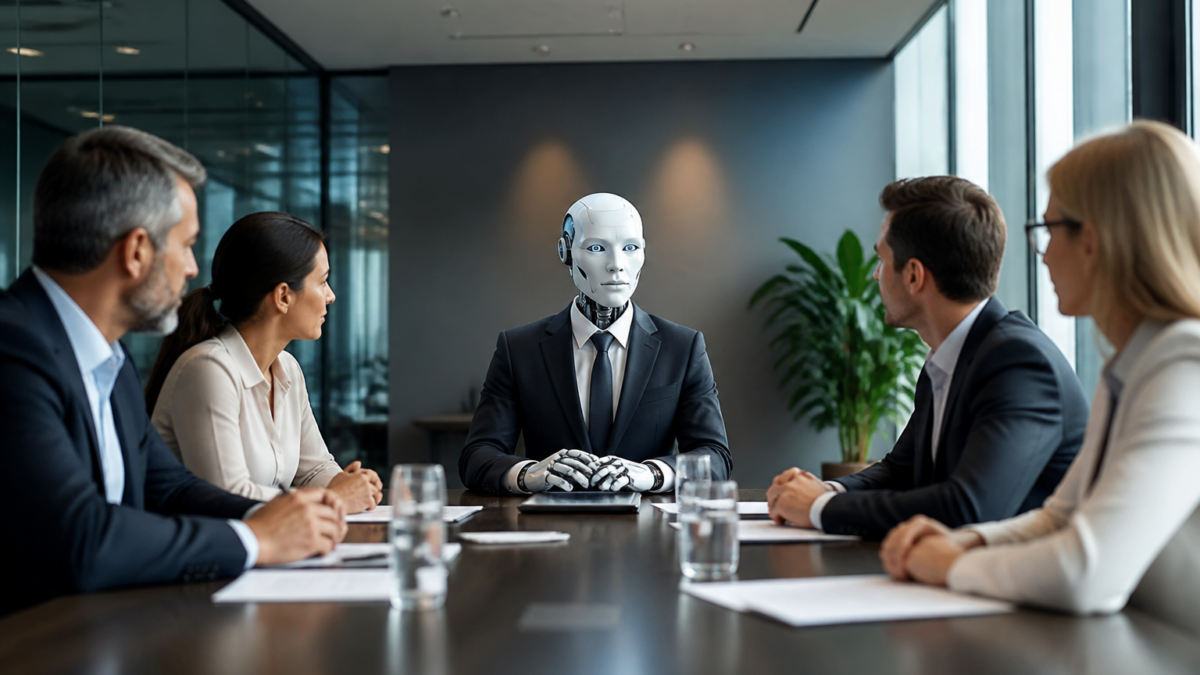
The most plausible near-term outcome is not an AI CEO sitting alone at the top of a company. It is a layered leadership model in which AI systems support executives, boards, finance teams, legal departments, human resources professionals, and operations leaders.
In that model, AI could provide continuous analysis and identify potential problems earlier. Human leaders would set priorities, interpret ambiguous situations, communicate decisions, and remain accountable for the company’s conduct. Boards would oversee both the executive team and the systems used to inform major decisions.
Some businesses may eventually operate with fewer traditional management layers because software can coordinate routine work more efficiently. That could change the scope of the CEO role, reduce the need for certain administrative functions, or lead to new titles focused on technology, risk, data, and organizational strategy. But organizational change is different from handing corporate authority to an unaccountable algorithm.
Frequently Asked Questions
Can AI replace CEOs today?
AI can perform or support many tasks associated with executive work, but it cannot generally replace the full legal, governance, and human responsibilities of a CEO. Companies still need accountable people to make or approve major decisions and to answer to boards, employees, investors, regulators, and customers.
What CEO tasks are most likely to be automated?
Routine analysis, reporting, forecasting support, meeting summaries, document preparation, workflow coordination, and certain monitoring tasks are among the more likely areas for automation. Strategic judgment, relationship management, ethical decisions, and crisis communication are less suitable for fully autonomous systems.
Does AI make business decisions unbiased?
No. AI may help identify patterns that people overlook, but it can also reflect biased data, flawed objectives, or incomplete assumptions. Responsible use requires testing, monitoring, transparency, and appropriate human review.
Who is responsible if an AI-supported decision causes harm?
Responsibility depends on the circumstances, contracts, company structure, applicable law, and how the system was designed and used. In practical terms, companies should not treat AI as a responsibility loophole. They should define accountable people and escalation procedures before deploying systems in consequential settings.
Bottom Line
AI may reduce the amount of routine work performed by CEOs and may change what boards expect from senior leaders. It can improve access to information, accelerate analysis, and support more disciplined planning. Those benefits are significant, but they do not prove that an AI system can replace corporate leadership altogether.
The central issue is not whether software can generate a recommendation. It is whether the recommendation is based on reliable information, aligned with the company’s obligations, understood by decision-makers, and subject to meaningful oversight. For the foreseeable future, the strongest model is likely to be AI-augmented leadership: machines handling more analysis and coordination while human executives and directors retain authority, judgment, and accountability.








Leave a Reply