

Affiliate marketing can be a useful growth channel for brands, publishers, creators, and niche website owners. At its best, it connects people who need help making a buying decision with relevant products or services, while giving the publisher an opportunity to earn a commission for a tracked outcome.
At its worst, affiliate marketing becomes a collection of thin pages, misleading claims, duplicate reviews, expensive paid-search overlap, and reports that overstate performance. The difference is strategy. Sustainable programs are built around useful content, clear rules, honest disclosures, strong measurement, and a realistic understanding of where affiliate traffic fits within SEO, PPC, email, social, and direct conversion paths.
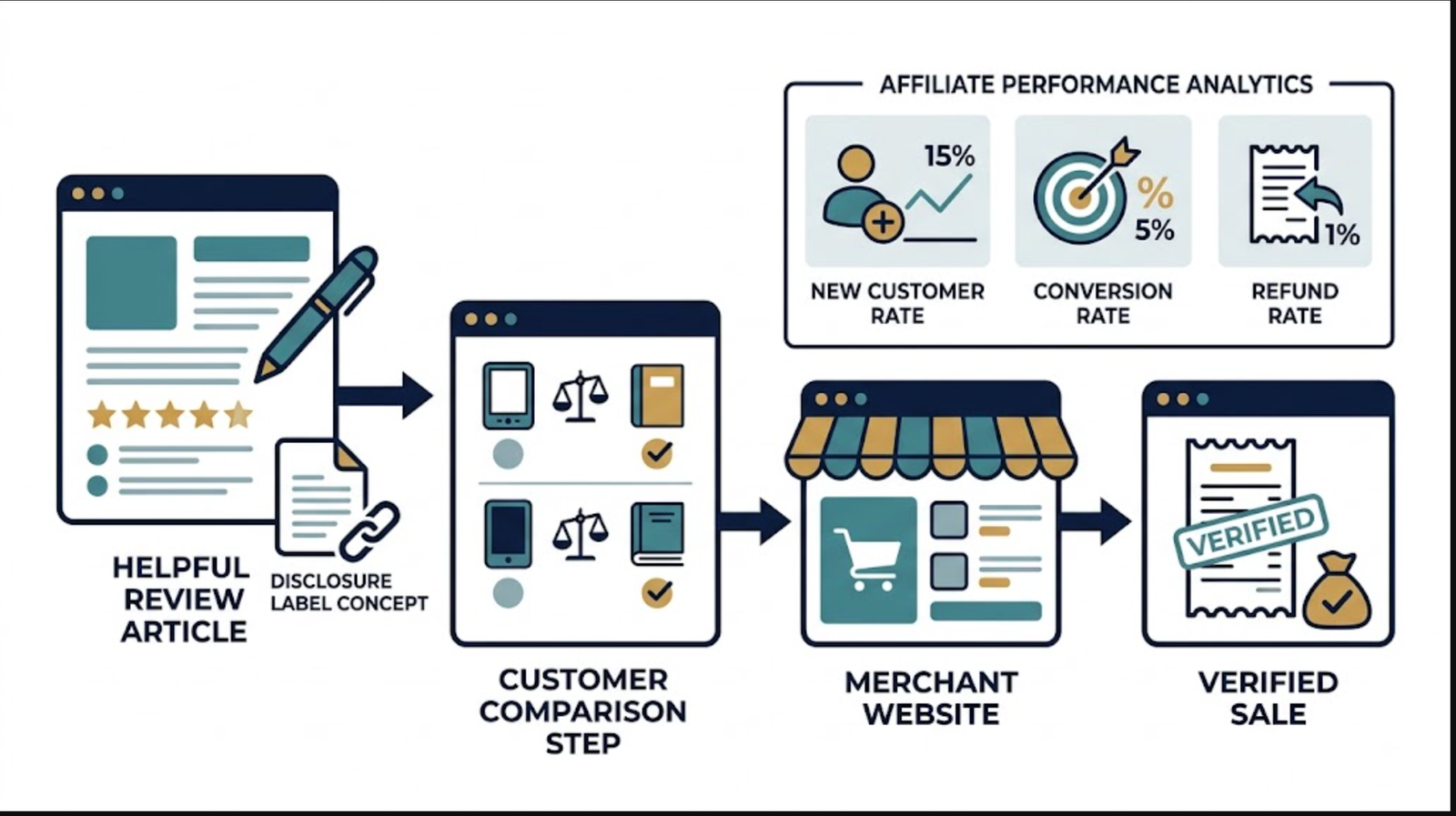
Affiliate performance should be evaluated across the full customer journey, not only by the final tracked click.
This guide explains how affiliate marketing works, when it makes sense, how to use it alongside search marketing, what to measure, and how both merchants and publishers can grow without sacrificing trust.
What Is Affiliate Marketing?
Affiliate marketing is a performance-based marketing arrangement. A business, often called the merchant, advertiser, or brand, works with a third-party partner, often called an affiliate, publisher, or creator. The affiliate promotes an eligible product, service, or offer using a unique tracking link, code, or other approved tracking method.
If a visitor completes a qualifying action, the affiliate may receive a commission. The qualifying event depends on the program and can include:
- A completed sale
- A qualified lead or submitted application
- A free-trial signup
- An approved subscription
- An app installation or another verified action
Commission structures vary widely. Some programs pay a percentage of sale value, while others offer a flat amount per approved lead or customer. Terms can also differ by product category, geography, device, attribution rules, refund period, and customer type. Always read the current program agreement before building a campaign around a projected commission rate.
The Main Parties in an Affiliate Program
| Party | Primary role | What success looks like |
|---|---|---|
| Merchant or advertiser | Provides the offer, landing pages, tracking, commission terms, and approvals. | Incremental customers, controlled costs, and brand-safe promotion. |
| Affiliate or publisher | Creates content, sends traffic, or introduces an audience to the merchant. | Useful content, qualified clicks, conversions, and sustainable revenue. |
| Affiliate network or platform | May provide tracking, reporting, payments, fraud controls, and program management. | Reliable tracking and efficient partner administration. |
| Customer | Researches, compares, clicks, and decides whether the offer is right for them. | Accurate information and a straightforward buying experience. |
The customer should remain the center of the model. If a page does not help someone evaluate a product, solve a problem, or understand meaningful tradeoffs, it is unlikely to become a durable asset for readers or search engines.
When Affiliate Marketing Makes Sense
Affiliate marketing works best when a partner can add something a merchant does not already own: a trusted audience, specialist expertise, useful comparison content, a strong newsletter, an active community, a product review process, or visibility for a high-intent search topic.
For example, a publisher that tests home-office equipment can create a detailed guide explaining monitor size, ergonomics, connectivity, and price ranges. Relevant affiliate links may be appropriate because the article helps readers narrow their choices. A generic page that copies product descriptions and lists dozens of links provides much less value.
Good Use Cases
- Product research: Reviews, alternatives, comparisons, buyer guides, and use-case recommendations.
- Niche education: Content that teaches readers how to choose software, tools, equipment, services, or subscriptions.
- Audience partnerships: Newsletters, communities, podcasts, and creators with a relevant, engaged audience.
- Geographic or vertical reach: Publishers serving a specific market, profession, hobby, or customer segment.
- New product discovery: Offers that benefit from explanation before purchase.
When It May Not Be the Best First Choice
Affiliate marketing may be a weak fit if a company has unclear conversion tracking, low margins, poor landing pages, inconsistent customer support, or no capacity to manage partner relationships. It can also disappoint when the product has little differentiation and affiliates can only compete by using aggressive discounts, unsupported claims, or brand-name search ads.
Publishers should be cautious when a program requires promotional tactics that do not fit their editorial standards or audience expectations. A short-term commission is rarely worth losing reader trust.
Affiliate Marketing, SEO, and Helpful Content
Affiliate marketing is not an SEO shortcut. Affiliate pages can rank in search results, but participation in an affiliate program does not create rankings. Search visibility depends on the overall quality and usefulness of a site, the relevance of its pages, technical accessibility, and many other signals.
Google’s spam policies specifically address thin affiliation: pages that primarily republish content from other sources without adding substantial value can be problematic. This does not mean affiliate links are prohibited. It means a publisher needs to add original value beyond the link itself.
What High-Value Affiliate Content Looks Like
A strong affiliate article should make a decision easier. Depending on the topic, that may involve hands-on testing, original photography, product research, a clear methodology, expert interviews, transparent comparison criteria, screenshots, pricing considerations, limitations, and alternatives.
Helpful content often answers questions such as:
- Who is this product or service best for?
- Who should avoid it?
- What are the important differences between options?
- What does the buyer need to know before spending money?
- What ongoing costs, restrictions, or compatibility issues may apply?
- What is the realistic downside of each choice?
SEO Content Formats That Can Support Affiliate Revenue
| Content type | Typical search intent | How it helps readers |
|---|---|---|
| Product review | Commercial investigation | Explains features, limitations, use cases, and whether the product is worth considering. |
| Comparison page | Decision-stage research | Shows meaningful differences between two or more options. |
| Best-of guide | Category discovery | Helps readers shortlist options using transparent selection criteria. |
| Alternatives guide | Problem-solving or replacement research | Helps visitors find options when a known product is not suitable. |
| How-to article | Informational | Teaches a process and recommends tools only where they genuinely help. |
| Use-case landing page | Specific commercial intent | Matches a product category to a defined need, industry, or workflow. |
Avoid Thin and Over-Optimized Pages
Do not create dozens of nearly identical pages that change only a city, keyword, product name, or affiliate link. Avoid copying manufacturer descriptions, publishing reviews of products you have not meaningfully researched, or using exaggerated claims such as “guaranteed best” without support.
Instead, build fewer pages with clearer intent and stronger evidence. Update them when products, prices, policies, features, or availability change. A useful affiliate content library is an editorial asset, not a list of ranking targets.
Disclosure, Trust, and Compliance Basics
Clear disclosure is essential. In the United States, the Federal Trade Commission has guidance on endorsements and material connections. If a publisher receives compensation, free products, discounts, or another meaningful benefit related to a recommendation, readers should be able to understand that relationship.
A disclosure should be easy to notice and understandable. It should appear close enough to the endorsement or affiliate links that a reader is likely to see it before making a decision. A vague statement hidden in a footer may not provide the clarity readers expect.
A practical disclosure can be simple: “This article contains affiliate links. If you buy through these links, we may earn a commission at no extra cost to you.” The exact wording should match the publisher’s relationship and should not imply that a reader will pay more if that is not true.
Trust-Building Practices for Publishers
- Explain how products were selected, tested, or researched.
- Distinguish editorial opinions from merchant-provided claims.
- Include meaningful drawbacks, not only benefits.
- Update content when facts materially change.
- Use disclosures that are clear, visible, and plain-language.
- Do not make earnings, health, legal, financial, or performance claims that cannot be supported.
- Use accurate calls to action instead of misleading urgency or fake scarcity.
Merchants should provide affiliates with accurate approved claims, current promotional terms, and clear brand guidelines. Both sides benefit when customers know what they are clicking and what they can reasonably expect.
Using Affiliate Marketing With PPC
PPC and affiliate marketing can work together, but they require firm boundaries. Without coordination, a brand’s internal paid-search team and its affiliates can bid against each other for the same audience. That can increase costs, confuse attribution, and allow a partner to earn commission for traffic the merchant could have acquired directly.
Common PPC Policy Decisions
Each program should document its own paid-media rules. Policies frequently address the following areas:
- Whether affiliates may bid on the merchant’s brand name or close variants.
- Whether affiliates can use brand terms in display URLs, ad copy, or ad assets.
- Whether direct linking from an ad to a merchant landing page is allowed.
- Whether affiliates may promote coupons, trademark terms, or competitor comparisons.
- Which geographies, audiences, and products are excluded.
- How paid social, retargeting, and shopping placements are handled.
There is no universal answer. A mature merchant might allow a small group of approved partners to run paid campaigns in underserved categories. Another brand may prohibit almost all affiliate PPC because it has a strong internal search operation. The important point is to make the rules specific, communicate them early, and enforce them consistently.
PPC Coordination Checklist
- Define protected brand terms and misspellings.
- List approved and prohibited ad placements.
- Set rules for coupon, loyalty, cashback, toolbar, and browser-extension partners.
- Share campaign calendars for major launches and promotions.
- Use tracking that identifies the partner and placement where possible.
- Review search-query overlap and conversion paths regularly.
- Pause or revise placements that increase cost without adding measurable value.
For publishers, PPC should not be used simply because a commission looks attractive. Test carefully, account for ad spend, refunds, conversion delays, and program restrictions, and avoid sending paid clicks to weak pre-sell pages.
Analytics: Measure More Than Last-Click Sales
Affiliate reporting often starts with clicks, conversions, conversion rate, revenue, and commissions. Those are important operational metrics, but they do not fully answer the business question: did the affiliate activity create new value, or did it mostly claim credit for customers who were already likely to buy?
Last-click attribution can over-credit partners who appear at the end of a conversion journey, particularly coupon and cashback sites. On the other hand, last-click reporting can understate the value of publishers that introduce a brand early through educational articles, reviews, videos, or newsletters.
Core Affiliate Marketing Metrics
| Metric | Why it matters | Question to ask |
|---|---|---|
| Clicks | Shows traffic volume and placement activity. | Is the partner reaching a relevant audience? |
| Conversion rate | Measures the share of tracked clicks that convert. | Does the traffic match the offer and landing page? |
| Average order value | Helps evaluate customer and order quality. | Are affiliate customers buying higher- or lower-value orders? |
| New-customer rate | Separates acquisition from repeat-customer capture. | Is the program bringing in people new to the brand? |
| Refund or cancellation rate | Identifies low-quality or mismatched promotion. | Do affiliate-driven customers remain valuable after purchase? |
| Commission cost | Shows direct channel expense. | Is the payout reasonable relative to margin and customer value? |
| Assisted conversions | Shows influence earlier in the journey. | Does the publisher help start or advance consideration? |
| Incremental lift | Estimates value that would not otherwise occur. | Would these conversions likely have happened without the partner? |
Ways to Assess Incrementality
Incrementality is difficult to measure perfectly, but it is worth investigating before scaling commissions. A business can compare partner types, evaluate new versus existing customers, review conversion paths, run controlled tests where practical, or temporarily limit selected placements to observe changes.
Potential approaches include:
- Partner segmentation: Compare editorial content partners, creators, loyalty sites, coupon sites, and paid-media partners separately.
- New-customer analysis: Review whether affiliates introduce customers who have not purchased before.
- Geographic or audience holdouts: Where feasible, exclude a defined group from a campaign and compare results carefully.
- Time-based tests: Pause a placement for a limited period while accounting for seasonality and other marketing changes.
- Path analysis: Review whether affiliates tend to initiate, assist, or close conversions.
No single report should be treated as absolute proof. Attribution tools rely on data availability, consent choices, browser behavior, tracking windows, and platform configurations. Use several signals and involve analytics, finance, and marketing stakeholders in major decisions.
How Merchants Can Build an Affiliate Program
A strong merchant program begins before recruitment. Affiliates cannot fix a confusing offer, a slow site, a poor checkout experience, or unclear positioning. First make sure the core customer journey is ready to convert.
Step 1: Define the Business Goal
Choose a primary purpose for the program. It might be new-customer acquisition, category awareness, regional expansion, content distribution, subscription growth, or support for a product launch. Avoid vague goals such as simply getting more affiliate sales. A defined objective makes partner selection and measurement much easier.
Step 2: Set Commercial Terms That Work
Build a commission model based on unit economics, expected refund rates, customer value, and operational costs. Consider whether different products, customer segments, or partner types deserve different terms. For example, an editorial partner that creates original product education may provide different value from a checkout-stage coupon partner.
Step 3: Create Clear Program Rules
Document promotional restrictions, disclosure expectations, brand usage rules, paid-search policies, prohibited claims, approval processes, and consequences for violations. Keep the language understandable. If partners cannot tell what is allowed, enforcement becomes inconsistent.
Step 4: Recruit for Relevance, Not Volume
Do not judge prospective affiliates only by follower count or traffic estimates. Review their audience fit, content quality, reputation, engagement, historical promotions, search visibility, and ability to explain the product accurately. A small specialist publisher can outperform a large but poorly matched site.
Step 5: Equip Partners to Succeed
Provide accurate product information, approved creative assets, tracking links, promotional calendars, brand guidelines, and a responsive contact person. Encourage affiliates to use their own voice and editorial process rather than publishing copied campaign language.
Step 6: Review Quality and Performance
Monitor traffic quality, conversion patterns, customer complaints, refunds, trademark use, and promotional placement. Review both top performers and inactive partners. A healthy program regularly removes poor-fit activity while investing more in transparent, useful, high-quality partnerships.
How Publishers Can Grow an Affiliate Business
For publishers, affiliate revenue is strongest when it is connected to an owned audience and credible editorial work. Search traffic can be valuable, but it should not be the only source of visitors. Email subscribers, returning readers, communities, social audiences, podcasts, and direct relationships make a publishing business more resilient.
Build Around a Defined Audience Need
Start with the problem your readers are trying to solve. A profitable niche is not necessarily one with the highest commission rate. It is one where you can build expertise, create useful resources, and earn repeat attention.
For instance, a site focused on remote work could cover workspace setup, software workflows, video conferencing, productivity methods, and buying guides. The affiliate opportunities should follow the content strategy, not replace it.
Create a Content-to-Conversion Path
Not every article should contain a sales-focused call to action. Informational guides can introduce readers to a topic, comparison pages can help them evaluate options, and focused reviews can support a decision when the reader is ready.
A balanced content plan may include:
- Educational articles that answer foundational questions.
- Comparison guides for readers evaluating alternatives.
- Detailed reviews with methodology and limitations.
- Resource pages that organize genuinely useful tools.
- Email content that follows up with additional help rather than repeated promotions.
Diversify Revenue and Traffic
Affiliate income can change when merchants revise terms, products go out of stock, search rankings move, or consumer demand shifts. Consider building a mix of revenue sources that may include display advertising, sponsorships, digital products, consulting, memberships, or direct partnerships where appropriate for your audience.
Diversification does not mean adding monetization everywhere. It means reducing dependence on any single merchant, traffic source, or short-lived tactic.
Common Affiliate Marketing Mistakes
Choosing Programs Only by Commission Rate
A high advertised commission can be less valuable than a lower-paying program with strong product-market fit, reliable tracking, high conversion quality, and a reputation readers trust. Consider the entire customer experience.
Writing Promotional Content Without Research
Readers can often recognize generic content. If you cannot test a product, explain what research you used and avoid claiming firsthand experience. Do not copy claims that you cannot verify.
Ignoring Existing Customers
Merchant programs can unintentionally pay commissions on customers who were already in the sales funnel. Review customer status, attribution paths, and partner behavior instead of relying only on total attributed revenue.
Using Misleading Coupons or Urgency
Expired coupon pages, fake countdowns, deceptive buttons, and unsupported “limited-time” claims can damage trust and create compliance problems. Promotional information should be current and accurate.
Failing to Maintain Content
Affiliate articles need maintenance. Products change, software features evolve, policies are updated, pricing changes, and merchants may end programs. Schedule periodic reviews for high-traffic and high-revenue pages.
Affiliate Marketing Strategy Checklist
- Define the customer and commercial problem the partnership should solve.
- Choose products or services that are relevant to the audience.
- Create original content that provides value beyond affiliate links.
- Use clear, prominent affiliate disclosures.
- Confirm merchant terms, brand rules, and paid-media restrictions.
- Track clicks, conversions, customer quality, refunds, and commission costs.
- Separate editorial, creator, coupon, loyalty, and paid-media partners in reports.
- Evaluate new-customer contribution and likely incrementality.
- Coordinate affiliate activity with SEO, PPC, email, and social teams.
- Review top pages and partner placements regularly for accuracy and compliance.
- Diversify traffic and revenue sources to reduce dependency risk.
Frequently Asked Questions
Is affiliate marketing legitimate?
Yes. Affiliate marketing is a common performance marketing model used by many businesses and publishers. Its quality depends on how it is implemented. Transparent disclosures, accurate information, useful content, and clear program rules are essential.
Is affiliate marketing an SEO strategy?
Affiliate marketing can use SEO to attract visitors to helpful reviews, comparisons, and buyer guides, but it is not an SEO strategy by itself. Pages still need original value, good technical foundations, and a strong match to search intent.
Can affiliate marketing work with PPC?
Yes, but merchants and affiliates need clear rules to prevent brand-bidding conflicts, duplicate spend, and misleading ads. PPC activity should be measured against total acquisition cost and incremental customer value.
How do affiliates get paid?
Payment depends on the program terms. An affiliate may earn a percentage of a sale, a fixed amount for a qualified lead, or another agreed payout for a tracked action. Payments can be affected by approval periods, returns, cancellations, and minimum payout thresholds.
What is the biggest affiliate marketing risk for merchants?
A major risk is paying for conversions that would have happened without the affiliate touchpoint. Other risks include low-quality traffic, policy violations, inaccurate claims, and damage to brand trust. Strong governance and measurement reduce these risks.
What is the biggest affiliate marketing risk for publishers?
Publishers can become overly dependent on one merchant, traffic source, or ranking page. They can also lose audience trust by promoting weak products or failing to disclose relationships. A long-term approach prioritizes credibility and diversified revenue.
Conclusion: Build Affiliate Marketing Around Value and Measurement
Affiliate marketing can help brands reach new audiences and help publishers monetize useful content. However, it works best as part of a broader digital marketing strategy rather than as an isolated tactic.
For merchants, the priorities are recruiting relevant partners, setting clear rules, protecting the customer experience, and measuring new-customer and incremental value. For publishers, the priorities are audience trust, original editorial value, transparent disclosure, and content that helps readers make informed decisions.
When SEO, PPC, analytics, and affiliate teams share goals and reporting, affiliate marketing can become a more reliable growth channel. Start with useful content and clean measurement, then scale the partnerships that create genuine value for customers and the business.
Sources for Further Review
- Federal Trade Commission: Endorsements, influencers, and disclosure guidance.
- Google Search Central: Search Essentials and spam policies, including guidance related to thin affiliate content.
- Google AdSense Program Policies: Content quality and publisher policy requirements.
Editorial note: Platform policies, affiliate program terms, tracking methods, product availability, and promotional rules can change. Verify important requirements with the relevant merchant, affiliate network, advertising platform, and official regulatory source before launching or scaling a campaign.










Leave a Reply