
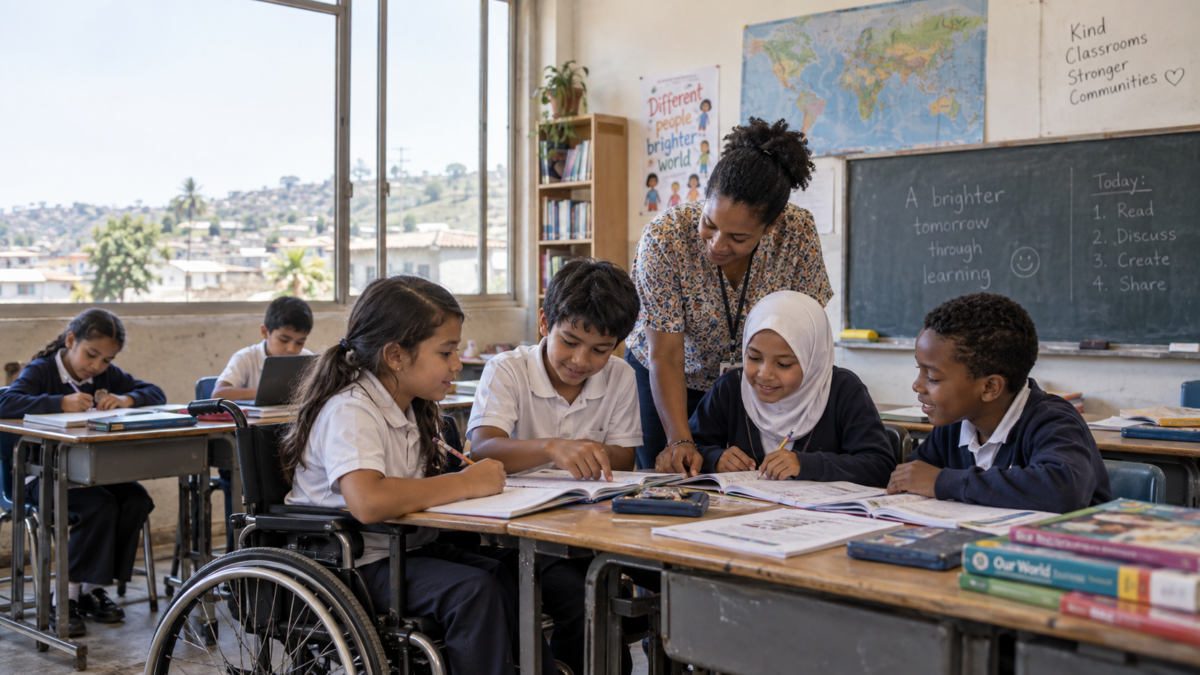
Quality Education for Children – UNICEF is about far more than getting children through a school gate. Quality education means that children can enter and remain in safe, inclusive learning environments, develop literacy and numeracy, learn from supported teachers, gain skills relevant to their lives and futures, and continue learning even when poverty, disability, displacement, conflict or climate emergencies disrupt normal schooling.
Education is also recognized as a child right. Articles 28 and 29 of the Convention on the Rights of the Child address access to education and the purpose of education, including developing a child’s personality, talents and abilities and fostering respect for rights, cultures and others. Sustainable Development Goal 4 similarly calls for inclusive and equitable quality education and lifelong learning opportunities for all.
UNICEF’s role is usually to support national and local education systems, not to directly run every school or programme discussed under its education work. Depending on the country and situation, that support can include policy advice, financing analysis, teacher development, learning materials, data systems, digital platforms, emergency learning spaces, inclusive education, curriculum reform and coordination among partners.
What Does Quality Education for Children Actually Mean?
Access is the starting point, but enrolment alone does not guarantee meaningful education.
A child may technically be enrolled while attending irregularly, sitting in an overcrowded classroom, learning in an unfamiliar language, lacking accessible materials, or progressing through grades without developing basic reading and mathematics skills. UNICEF’s education strategies increasingly focus on the difference between being in school and actually learning. Its 2019–2030 Every Child Learns strategy emphasizes improved learning outcomes and a broader set of skills that help children and adolescents navigate education, work and civic life.
A quality education system therefore needs several elements working together.
| Element | Why it matters |
| Access and participation | Children need realistic ways to enter school, attend regularly and complete each stage of education. |
| Foundational literacy and numeracy | Reading, comprehension and basic mathematics support almost every later area of learning. |
| Qualified and supported teachers | Good teaching depends on preparation, professional development, suitable working conditions and appropriate deployment. |
| Inclusive classrooms | Disability, gender, poverty, ethnicity, language or migration status should not determine who can learn. |
| Safe learning environments | Children need protection from violence, discrimination, exploitation and environmental hazards. |
| Relevant learning materials | Curriculum, textbooks and digital resources need to be understandable, accessible and suited to learners’ contexts. |
| Skills development | Adolescents need transferable, digital, socio-emotional and job-related skills alongside academic knowledge. |
| Learning measurement | Education systems need reliable evidence about who is learning, who is falling behind and where resources are needed. |
These ideas closely align with SDG 4. Its targets cover free and effective primary and secondary education, early childhood education, skills for employment, equity for vulnerable groups, literacy and numeracy, safe and inclusive facilities, and increasing the supply of qualified teachers.
Why foundational learning is central
Reading and numeracy acquired during the early years are often described as foundational because later learning builds on them. A learner who cannot understand a simple text will struggle to access science, history, vocational education and even written instructions in everyday life.
UNICEF’s 2026 Education Strategy cites an estimate that roughly 70% of 10-year-olds in low- and middle-income countries cannot read and understand a basic sentence. That estimate reflects the learning-poverty crisis documented jointly by the World Bank, UNICEF, UNESCO and other partners; the widely cited global estimate was published in 2022 and should therefore be understood in that dated context rather than treated as a newly measured 2026 rate.
The problem is not only children being out of school. Many children attend school but are taught at a level that does not match what they actually understand. Language differences, limited teacher support and insufficient learning resources can widen those gaps further. UNICEF’s current foundational-learning work consequently emphasizes approaches that meet learners at their level, including adaptable and accessible resources.
The Global Education Challenge: Who Is Still Being Left Behind?
Featured Image for “Quality Education for Children – UNICEF: How Learning and Educational Access Are Supported Worldwide”.
The world has expanded access to education substantially over recent decades, but progress has slowed and major inequalities remain.
UNESCO’s latest monitoring reports that 273 million children and youth were out of school in 2024. This included approximately 79 million children of primary-school age, 64 million of lower-secondary age and 130 million of upper-secondary age. UNESCO notes that the overall global out-of-school rate has remained close to 17% since 2015 and is much higher in low-income countries.
That is why global education policy increasingly focuses on who is excluded, rather than looking only at overall enrolment averages.
Major barriers to quality education
Poverty can affect education through school-related costs, transportation expenses, pressure to work, food insecurity and unstable housing. Even where tuition is officially free, indirect costs can push children out of school.
Gender inequality operates differently across settings. Girls may face child marriage, gender-based violence, safety concerns, restrictions on mobility or insufficient sanitation facilities. Boys in some contexts experience pressure to enter paid work or disengage from school. UNICEF therefore frames gender-equitable education as an issue affecting both access and learning.
Disability remains a major source of exclusion. UNICEF estimates that around 240 million children worldwide live with disabilities. Barriers can include inaccessible buildings, stigma, a lack of assistive technology, unsuitable teaching materials and teachers who have not received enough preparation for inclusive education.
Conflict and displacement can destroy schools, separate families, interrupt records and certification, and force children to learn in temporary locations. UNICEF reports that more than 50 million children have been forcibly displaced worldwide and that nearly half of school-age refugee children are out of school.
Climate-related emergencies increasingly interrupt schooling. UNICEF’s latest global snapshot found that more than 171 million students in 106 countries or territories experienced school disruption from climate hazards in 2025, including storms, floods, heatwaves, droughts and wildfires. The figure should not be confused with UNICEF’s 2024 estimate of 242 million affected students; they cover different years and country samples.
Teacher shortages affect class size, subject availability and the amount of individual support teachers can provide. UNESCO’s 2024 Global Report on Teachers estimated that 44 million additional primary and secondary teachers would be needed globally by 2030 to reach universal education goals.
Other barriers include shortages of textbooks and learning materials, inadequate school infrastructure, linguistic differences between students and instruction, discrimination against minority groups, poor connectivity and unequal access to devices and electricity.
These disadvantages often overlap. A displaced girl with a disability from a low-income household, for example, may face several barriers simultaneously. That is one reason UNICEF’s current strategy emphasizes equity rather than assuming a single intervention will work equally for every learner.
How UNICEF Supports Quality Education for Children
Featured Image for “Quality Education for Children – UNICEF: How Learning and Educational Access Are Supported Worldwide”.
UNICEF works across early childhood, primary and secondary education, skills development and humanitarian response. The specific activities vary by country because governments remain responsible for their national education systems.
Early childhood education
Early childhood learning prepares children for the transition into primary school. UNICEF’s 2026 strategy treats early childhood development, care and pre-primary education as part of a learning continuum rather than as an optional stage before “real” schooling.
The strategy says UNICEF will support governments in strengthening childcare and pre-primary systems, parental engagement, early childhood educators, playful learning and early literacy, numeracy and socio-emotional development. It also advocates a benchmark of allocating 10% of public education budgets to pre-primary education.
UNICEF’s strategy also identifies 29 million 5-year-olds who are excluded from organized early learning, illustrating why pre-primary access remains a substantial part of the global education agenda.
Foundational literacy and numeracy
UNICEF describes its newer approach as Foundational Learning 2.0. It includes evidence-based teaching approaches such as structured pedagogy and Teaching at the Right Level, alongside catch-up education and digital tools that can help learners who have fallen behind.
The goal is not simply to distribute materials or place technology in classrooms. Governments are encouraged to embed effective approaches in curricula, teacher professional-development systems, assessments and education-sector plans so that successful methods can reach large numbers of learners sustainably.
Inclusive education
Inclusive education means designing systems so that children with different abilities, backgrounds and circumstances can participate together.
UNICEF’s 2026 strategy describes a “twin-track” approach to disability inclusion: mainstream accessibility throughout education planning and financing while also providing targeted support where individual children need it. Measures can include inclusive teaching methods, universally designed curricula and assessment, assistive technology and individualized support.
Gender-responsive teaching and curriculum are another part of inclusion, along with efforts to address school-related gender-based violence, girls’ secondary-school completion and boys’ disengagement.
Teachers and teaching quality
UNICEF’s Education Strategy 2026 puts teacher workforce development near the centre of system transformation. Its priorities include stronger pre-service and in-service development, professionalizing teaching, improving teacher deployment, strengthening constructive accountability systems and supporting teachers working in crisis settings.
The emphasis on deployment matters because a country can have a substantial teaching workforce overall while still leaving rural, poor or crisis-affected communities with serious shortages.
In emergency situations, UNICEF also recognizes the role of community and volunteer teachers who may work outside normal professional structures. Its strategy proposes adapted training, professional pathways and mental-health and psychosocial support for these educators.
Secondary education and skills for adolescents
Education cannot stop at basic literacy.
Secondary education increasingly needs to help adolescents build transferable skills such as communication, problem-solving, collaboration, socio-emotional skills, digital competence, financial literacy and practical knowledge related to employment.
UNICEF’s 2026 strategy calls secondary education a “missing middle” that has often received less attention than primary or tertiary education. It supports governments in areas such as competency-based curricula, stronger assessments, teacher development, career guidance, modernized technical and vocational education, flexible learning pathways and alternatives for adolescents who have left formal education.
For young people who missed foundational learning earlier, programmes may need to combine remedial literacy and numeracy with practical, vocational and transferable skills rather than expecting adolescents simply to re-enter a conventional age-based classroom.
Digital learning without widening the digital divide
Technology can expand educational access, but a tablet or online platform is not automatically a quality-education intervention.
UNICEF’s Digital Education Strategy 2025–2030, published in January 2026, specifically focuses on learning outcomes and reducing digital divides related to gender, disability and language. The strategy calls for approaches that can work for children both inside and outside school and in low-connectivity environments.
UNICEF’s broader 2026 Education Strategy takes a similar position on AI and educational technology. It argues that technology should support teachers rather than replace them and that systems need safeguards related to equity, transparency, data protection, linguistic diversity and educational impact. Offline and low-bandwidth options are particularly important in fragile settings.
A practical illustration is UNICEF’s Learning Passport. Its 2025 annual report says the platform was active in 51 countries and had reached 12.5 million learners and educators cumulatively, including use in crisis settings through offline and low-bandwidth options.
UNICEF’s “Every Child Learns” Approach and Education Strategy 2026
UNICEF’s Every Child Learns strategy, launched for 2019–2030, marked a shift from measuring education mainly through inputs and enrolment toward asking whether children are actually developing knowledge and skills. It also emphasized the range of competencies children need for personal, social, academic and economic life.
In September 2026, UNICEF published Shaping the Future of Learning: Education Strategy 2026. It does not replace the 2019–2030 strategy; UNICEF says it complements it by clarifying priorities, partnerships and the operating model for implementing the UNICEF Strategic Plan 2026–2029.
The strategy organizes the crisis around three related problems:
- Learning denied: children cannot access education.
- Learning delayed: children attend but do not acquire expected foundational knowledge and skills.
- Learning disrupted: conflict, climate shocks, displacement or other emergencies interrupt education.
It then proposes two broad shifts.
Shift 1 concerns what UNICEF supports: stronger teaching workforces, early childhood and foundational learning, secondary education and skills, inclusive education, responsible use of AI and education technology, support for out-of-school children, and education systems designed for climate and crisis resilience.
Shift 2 concerns how UNICEF works: moving from isolated projects toward systems-focused support, government budget and financing reform, stronger use of learning data, partnerships and technical assistance designed to produce scalable national results.
This direction is also linked to UNICEF’s Strategic Plan 2026–2029, which sets an impact ambition of 350 million more children and young people learning and skilled. The education strategy includes related result streams for children in school, children achieving minimum learning proficiency and young people developing skills for work and life. These are organizational targets, not already achieved outcomes, and the categories should not simply be added together because beneficiaries and measurement frameworks may overlap.
How this supports SDG 4
UNICEF’s priorities align closely with SDG 4:
| UNICEF education focus | Related SDG 4 area |
| Primary and secondary access and learning | Target 4.1 |
| Early childhood and pre-primary education | Target 4.2 |
| Adolescent and employment-related skills | Target 4.4 |
| Gender, disability and vulnerable children | Target 4.5 |
| Literacy and numeracy | Target 4.6 |
| Safe and inclusive schools | Target 4.a |
| Teacher development | Target 4.c |
UNICEF is one organization within the broader international effort. UNESCO has the central normative and coordination role for the global Education 2030 agenda, while governments remain responsible for delivering national education commitments. UNICEF contributes through child-rights programming, technical support, evidence, advocacy, humanitarian operations and system strengthening.
Education During Conflict, Displacement and Natural Disasters
For a child affected by war, forced migration, an earthquake, flood or cyclone, education can disappear suddenly even after years of regular attendance.
UNICEF describes education in emergencies as both a learning service and an important protective structure. Schools and temporary learning spaces can connect children to trusted adults, routines, psychosocial support, health and hygiene services and protection mechanisms.
Depending on the emergency, UNICEF-supported responses may include temporary learning spaces, education supplies, catch-up classes, teacher support, remote or offline learning, school rehabilitation, coordination of humanitarian education partners and assistance to education ministries.
UNICEF co-leads the Global Education Cluster and maintains responsibilities for education coordination in humanitarian settings. Its 2026 strategy emphasizes linking emergency response with national system strengthening so that temporary programmes do not unnecessarily become permanent parallel structures.
Climate resilience is becoming part of the same discussion. UNICEF’s strategy calls for climate-resilient school infrastructure, disaster-risk planning, portable connectivity and learning systems capable of continuing when physical schools cannot operate.
This is especially important because crises rarely affect everyone equally. Children already facing poverty, disability, gender discrimination or geographic isolation are often the least able to absorb another disruption.
Partnerships and System Strengthening: What UNICEF Actually Does
A common misunderstanding is that UNICEF directly operates the education systems associated with its name. In most settings, it does not.
National governments and ministries usually manage public education. Local authorities, schools and teachers deliver schooling. UNICEF can provide technical expertise, supplies, funding support, programme implementation assistance, research, data tools, advocacy and coordination depending on the agreement and context.
UNICEF’s 2026 strategy explicitly places government leadership at the centre and describes collaboration with UNESCO, the World Bank, the Global Partnership for Education, Education Cannot Wait, UNHCR, regional institutions, civil society, development banks and private-sector partners.
Community participation is equally important. Families and local leaders can influence enrolment, girls’ participation, attendance, disability inclusion and attitudes toward children who have been displaced. A technically strong education policy can still fail if communities do not trust it or if families cannot afford the indirect costs of participation.
How progress can be measured
Quality education requires measurable outcomes rather than activity counts alone. Useful indicators include:
- school enrolment and attendance;
- transition and completion rates;
- reading and mathematics proficiency;
- participation in early childhood education;
- gender, disability and income-group gaps;
- availability and qualifications of teachers;
- access to learning materials;
- adolescent skills acquisition;
- successful re-entry after displacement or dropout;
- access to safe, inclusive and climate-resilient learning environments.
UNICEF’s 2025 Annual Report, published in 2026, reported that it and its partners supported 27.8 million out-of-school children across 90 countries with access to education, with 51% of those children being girls. It also reported that more than 13.6 million children in 71 countries accessed education through digital platforms and that 57% of countries had inclusive and gender-responsive education systems according to UNICEF’s programme measurement framework, up from 47% in 2022. These are UNICEF-supported results and should not be interpreted as UNICEF alone operating the schools or systems involved.
For additional context, UNICEF’s 2024 education results reported 26 million children and adolescents accessing education through UNICEF-supported work and more than 17.5 million receiving learning materials.
Why Quality Education Matters for Development, Equality and Poverty Reduction
Education gives children more than academic knowledge. It can expand later options in employment, further study and participation in social and civic life.
Economic evidence also links education and skills with productivity, earnings and poverty reduction. The World Bank describes education as an important instrument for reducing poverty and inequality, while also stressing that how education money is spent matters: simply increasing expenditure without improving efficiency, teaching quality and learning outcomes does not automatically deliver better results.
The equity dimension is equally important. If high-quality schools are concentrated in wealthy cities while poor, rural, disabled, migrant or conflict-affected children receive weaker services, education can reproduce inequality rather than reduce it.
Quality education therefore requires both average improvement and narrower gaps between population groups.
A practical quality-education checklist
A programme or education system is more likely to support meaningful learning when it can answer “yes” to questions such as these:
- Can marginalized children realistically enrol and remain in education?
- Are students learning foundational reading and mathematics rather than only progressing through grades?
- Are teachers trained, supported and distributed fairly?
- Are classrooms safe and accessible to children with disabilities?
- Are girls and boys able to participate without discrimination or violence?
- Are learning materials relevant, understandable and available in appropriate formats and languages?
- Are digital tools improving learning rather than simply increasing device use?
- Is there a plan for continued education during conflict, climate shocks or displacement?
- Are outcomes measured and used to improve policy and spending?
Challenges UNICEF Faces in Expanding Educational Access
UNICEF operates within education systems shaped by government capacity, domestic budgets, conflict, infrastructure, teacher availability and political conditions. It cannot resolve these challenges through education projects alone.
One growing constraint is financing. UNICEF projected in 2025 that international aid to education could decline by US$3.2 billion by 2026, or 24% compared with 2023, and estimated that such cuts could put another 6 million children at risk of being out of school by the end of 2026. This is a projection based on announced aid reductions, not a confirmed final 2026 outcome.
Other constraints include prolonged conflicts, climate shocks, displacement, rapidly growing student populations, weak data systems, teacher shortages and the challenge of expanding technology without deepening digital inequality.
UNICEF’s latest strategy responds by placing more emphasis on national budgets, system reform, evidence, teacher support and scalable approaches rather than depending primarily on short-term standalone projects.
The underlying principle is straightforward: lasting progress requires governments and education systems to be able to continue delivering quality learning after an individual programme or funding cycle ends.
8. FAQ Section
1. What does UNICEF mean by quality education for children?
UNICEF generally treats quality education as a combination of access, inclusion and meaningful learning. Children should not only be enrolled but also develop foundational literacy and numeracy, learn in safe environments, receive support from capable teachers and acquire skills relevant to later education, work and life. UNICEF’s approach increasingly emphasizes measured learning outcomes rather than school attendance alone.
2. Does UNICEF run schools around the world?
Not generally. National and local governments normally operate public education systems. UNICEF works with governments, schools, communities and partner organizations by providing technical assistance, supplies, policy support, data systems, emergency education, teacher-development support and other assistance. In humanitarian emergencies, UNICEF may take a more operational role, including helping establish temporary learning services, but this should not be confused with owning or managing every participating school.
3. What is UNICEF’s Every Child Learns strategy?
Every Child Learns is UNICEF’s Education Strategy 2019–2030. It emphasizes moving beyond education inputs toward improved learning outcomes and helping children and adolescents develop a broad set of skills. UNICEF’s Education Strategy 2026 builds on that framework rather than replacing it, with additional emphasis on teachers, foundational learning, secondary education, digital technology, equity, emergencies and education-system transformation.
4. How many children are currently out of school worldwide?
UNESCO’s latest global monitoring reports 273 million children and youth out of school in 2024. Of these, about 79 million were of primary-school age, 64 million of lower-secondary age and 130 million of upper-secondary age. Estimates can change as population data and crisis information are updated, so the year and methodology should always accompany the number.
5. How does UNICEF help children during wars and disasters?
UNICEF can support temporary learning spaces, learning materials, teachers, remote learning, education-system recovery, psychosocial support and humanitarian coordination. Its 2026 strategy also calls for emergency programmes to strengthen national systems rather than automatically creating long-term parallel structures. UNICEF co-leads global education coordination for humanitarian responses through the Global Education Cluster.
6. Why does UNICEF focus so strongly on literacy and numeracy?
Reading and numeracy are foundational skills needed for later academic subjects and many everyday tasks. UNICEF’s 2026 strategy cites the continuing learning-poverty crisis among 10-year-olds in low- and middle-income countries and promotes approaches such as structured pedagogy, Teaching at the Right Level, catch-up education and stronger assessment systems.
7. How does UNICEF support children with disabilities?
UNICEF promotes disability-inclusive education by helping education systems address accessibility in planning, financing, curricula, assessments, teaching methods and technology. Its 2026 strategy also supports targeted measures such as assistive technology, individualized support and universally designed learning materials where needed. UNICEF estimates that approximately 240 million children worldwide live with disabilities.
8. How is UNICEF’s education work connected to SDG 4?
SDG 4 aims to ensure inclusive and equitable quality education and lifelong learning. UNICEF’s work contributes to targets covering early childhood education, primary and secondary learning, literacy and numeracy, vulnerable learners, adolescent skills, safe schools and qualified teachers. UNICEF works alongside governments, UNESCO and other international and national partners rather than acting as the sole agency responsible for achieving SDG 4.
9. Conclusion
Quality Education for Children – UNICEF reflects a broader idea than universal school enrolment. Children need access to education, but they also need to learn, remain safe, participate without discrimination and develop skills that allow them to continue learning and prepare for adult life.
The scale of the challenge remains substantial. UNESCO reports 273 million children and youth out of school in 2024, while millions more attend school without developing expected foundational skills. Conflict, displacement, disability, poverty, teacher shortages and increasingly frequent climate disruptions add further pressure.
UNICEF’s response is increasingly centred on strengthening national education systems rather than relying on isolated projects. Its Every Child Learns framework and Education Strategy 2026 emphasize foundational learning, teachers, equity, adolescent skills, responsible digital education, emergency resilience, evidence and sustainable financing.
For readers evaluating education programmes or policies, the central question is therefore not simply “How many children entered school?” It is also “Who was reached, who was excluded, what did children learn, and can the education system sustain those results?”














Leave a Reply