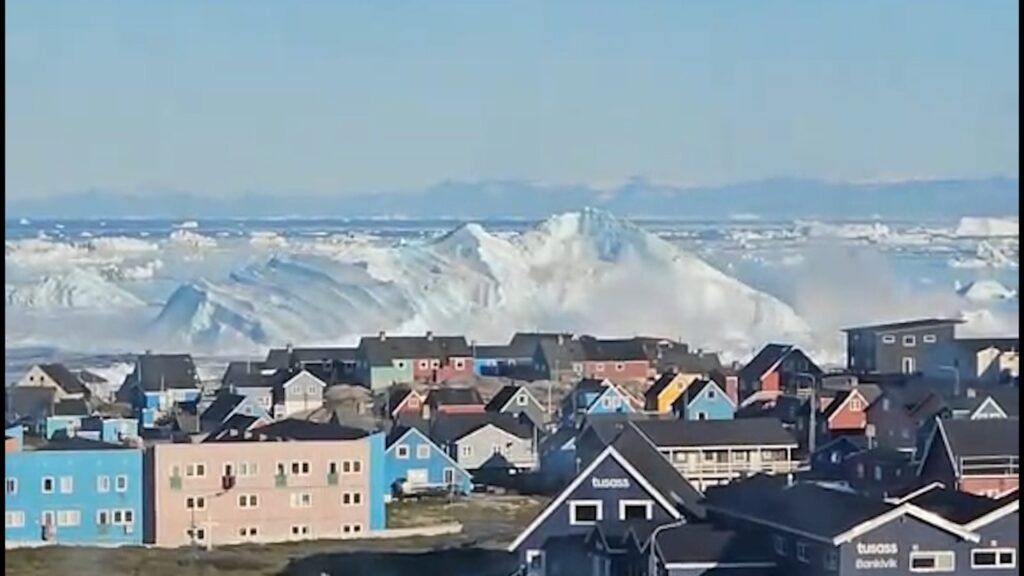
Massive Iceberg Capsizes Near Ilulissat, Greenland: A Display of Nature’s Power
ILULISSAT, GREENLAND — A colossal iceberg off the coast of Greenland has dramatically capsized, unveiling its rugged and serrated underside in an awe-inspiring spectacle that underscores the dynamic and unpredictable nature of the Arctic environment. The incident, which occurred in the vicinity of the bustling town of Ilulissat, was captured on video by both local residents and researchers, drawing immediate attention from climate scientists and environmentalists worldwide.
The Incident: Eyewitness Accounts
Witnesses described the iceberg, a massive structure estimated to be the size of several football fields, as it flipped with monumental force, a powerful movement that sent waves crashing against nearby fjords. “It was like watching a skyscraper crash over onto itself,” said local resident Lars Jensen, who was present at the shoreline when the iceberg began its transformation. “The sound was deafening, like thunder rumbling through the depths of the earth.”
The extraordinary event took place on Tuesday afternoon, as video footage shared across social media showed the iceberg momentarily pausing before dramatically rolling over. This mesmerizing yet concerning incident serves as a poignant reminder of the ongoing effects of climate change and the increasing instability of ice formations due to rising global temperatures.
Environmental Implications
The capsizing of the iceberg has raised alarms within the scientific community regarding the state of Greenland’s glaciers and their ability to withstand the dual forces of climate change and oceanic warming. According to Dr. Marisa Keenan, a leading glaciologist at the University of Copenhagen, this incident is not isolated. “We’re observing a trend where large icebergs are becoming increasingly unstable and prone to dramatic shifts,” she explained. “The more frequently we witness such incidents, the more we must scrutinize their implications for sea-level rise globally.”
- Immediate Threat: The disturbance caused by the iceberg could create localized tsunamis or massive waves that threaten nearby coastal settlements and maritime navigation.
- Long-term Effects: The melting of such large ice masses contributes significantly to rising sea levels, which poses risks to coastal communities across the globe.
- Wildlife Impact: The sudden change in the local seascape can also affect marine ecosystems, altering habitats for vital species.
The Broader Context: A Warming Arctic
The capsizing incident in Ilulissat is emblematic of a much broader issue confronting the Arctic region. According to the latest report from the Intergovernmental Panel on Climate Change (IPCC), Arctic temperatures have been rising at nearly twice the global average, leading to accelerated ice melt across the region. Former National Oceanic and Atmospheric Administration (NOAA) scientist Dr. Paul Slinger emphasized the significance of this event, stating, “This tipping point is a glaring indication of a fragile ecosystem under siege. What we saw this week serves as a stark reminder of all that is at stake.”
As icebergs continue to break off glaciers at alarming rates, the implications extend far beyond the Arctic communities. For coastal cities worldwide, including New York, Miami, and Jakarta, the increasing rise in sea levels is expected to prompt major re-evaluations of urban planning and disaster preparedness strategies.
Community Reactions and Concern
The community of Ilulissat has long been acquainted with the majestic yet temperamental beauty of its natural surroundings. Nevertheless, reactions to the iceberg’s capsizing have been mixed—while the event attracted awe and wonder among tourists and residents alike, it has also sparked fears regarding the stability of their environment.
Mayor Astrid Nielsen commented on the event’s significance: “While we are proud of our town’s breathtaking landscapes, events like this serve as a critical alert. It is a reminder that our environment is changing rapidly, and we must adapt to those changes. We are facing challenges that previous generations could hardly have imagined.”
Looking Ahead: The Future of Icebergs and Climate
As iconic as icebergs are to the Arctic’s identity, their disappearing quantity raises tough questions for scientists and policymakers alike. The urgency to act against climate change has never been clearer, as the melting ice contributes not just to rising sea levels, but also to the disruption of the oceanic currents that regulate the planet’s climate.
For Ilulissat and similar Arctic communities, the capsizing iceberg serves as a cardinal reminder of the intricate tapestry of global interdependence woven through climate systems. Addressing the root causes of climate change through advocacy for sustainable practices and international collaboration will be crucial. The stakes are no longer confined to the Arctic but extend to all corners of our planet.
In a world where icebergs once symbolized stability and permanence, their recent actions reflect a changing narrative—one filled with uncertainty and the compelling call to reshape our futures.
Source: Original Source