Escalation of Violence: Israeli Settlers Accused of Attacks in West Bank
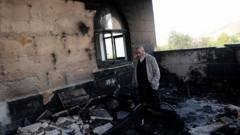
In a troubling escalation of tensions in the Israeli-Palestinian conflict, Israeli settlers were reported to have set fire to multiple mosques, vehicles, and agricultural land in the West Bank. The incidents are said to be retaliatory actions following a deadly clash between settlers and Palestinians that claimed the lives of four Palestinians and two Israelis near the village of Tell just two days prior.
A Cycle of Violence
The recent spate of violence marks a significant increase in hostilities in a region already fraught with deep-seated tensions. The attacks reportedly occurred late Tuesday night and into early Wednesday morning, as multiple eyewitness accounts detailed a scene where settlers indiscriminately targeted religious sites, civilian vehicles, and local farmland.
Local Palestinian authorities condemned the incidents as “criminal acts fueled by hatred,” emphasizing that such violence only serves to exacerbate already volatile relations between the communities. “These acts are not isolated; they contribute to a broader pattern of aggression that undermines any hope for peace,” said a spokesperson for the Palestinian Authority.
Background of the Conflict
The village of Tell, situated between Nablus and Jenin in the northern West Bank, has been a hotbed for disputes between Israeli settlers and the Palestinian population. The clashes leading to the recent violence were reportedly triggered by a confrontation over land disputes, which are all too common in this contested area.
The Israeli settlement policies in the West Bank are considered illegal under international law, although Israel disputes this interpretation. Settlements continue to expand, encroaching on Palestinian land and prompting ongoing unrest. In 2022 alone, United Nations figures showed a significant rise in violence, with over 300 Palestinians killed in the West Bank by Israeli forces and settlers, compared to around 30 Israelis killed by Palestinian attacks.
The Recurrence of Tensions
This recent wave of violence comes against the backdrop of an already heightened state of alert in the region, particularly following a series of clashes during last week’s Jewish holidays. The situation remains tense, with fears of further escalation as more settlers have begun to mobilize in reactions to perceived threats from Palestinians.
As violence continues, residents of the region have found themselves in an increasingly precarious position. “We live in constant fear,” said Ahmad, a resident of Tell. “Every day we witness attacks, and we no longer feel safe in our own homes.” His sentiments echo those of many Palestinians who have experienced the brunt of this ongoing conflict on a daily basis.
International Reactions
The international community has remained largely concerned but has yet to formulate a cohesive response to these latest events. The United Nations and several human rights organizations have urged both sides to exercise restraint. A recent statement from the U.N. called for an immediate cessation of violence and urged dialogue as the only viable pathway toward resolution.
- UN Secretary-General António Guterres: “It is of utmost importance that both parties refrain from actions that could lead to deeper conflict.”
- European Union’s foreign policy chief Josep Borrell: “The cycle of violence must be halted to prevent further loss of life. It is essential for both sides to engage in meaningful negotiations.”
Despite calls for restraint, however, the cycle of violence persists. Reports have emerged suggesting that settler groups are increasingly emboldened, believing they have the tacit approval of influential political leaders in Israel. This perception has led to bolder actions, resulting in a climate of fear among Palestinian communities.
Community Response and Resilience
In the face of such hostility, the Palestinian community in the West Bank is displaying commendable resilience. Local leaders have begun to organize grassroots efforts to bolster community security and solidarity amidst the chaos. Town halls and communal gatherings are being held to unite residents and provide support to those affected by the violence.
“We are determined to stand together against this brutality,” stated Mariam, a member of a local activist group. “We will not allow fear to dictate our lives, nor will we let our cultural and religious heritage be destroyed by hatred.”
Looking Ahead
The coming days could prove crucial in determining whether this latest flare-up in violence will lead to further escalations or a renewed focus on dialogue and conflict resolution. With tensions running high and no easy solutions in sight, the international community continues to urge restraint from both Israeli settlers and Palestinian militants alike.
As the situation develops, both sides remain entrenched in their respective narratives, leaving the broader quest for peace hanging in a delicate balance.
Source: Original Source